Financial Goals Examples Across Budgeting, Debt, Savings, and Net Worth
By Cells and Cents. Published November 7, 2026.
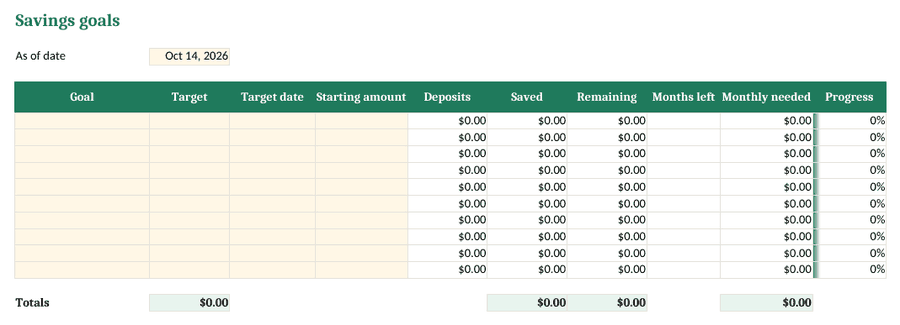
Financial goals examples cover budgeting, debt payoff, savings (including emergency and sinking funds), and net worth. Each example pairs a clear dollar amount with a target date, then uses a matching tracker: a budget sheet, a debt payoff planner, a savings goals tracker, or a net worth tracker.
This is for informational purposes only and is not tax, legal, or financial advice.
Below we define what counts as a financial goal, walk through financial goals examples by category, show how to turn an example into a trackable plan, and recalculate three made-up savings goals in our Savings Goals Tracker. For the monthly savings math itself, see how to set a savings goal.
What counts as a financial goal
"Get better with money" is hard to act on. "Save $600 for holiday gifts by December 15" is not, because it names the amount and the date.
The Consumer Financial Protection Bureau's Setting SMART goals tool (part of its Your Money, Your Goals toolkit) describes SMART goals as Specific, Measurable, Achievable, Relevant and Time bound. For money goals, that usually means:
- Specific: what the goal is about (a bill cycle, a debt, a purchase, or a balance sheet).
- Measurable: a dollar amount, so you know when it is done.
- Achievable: an amount per month or week you can actually set aside or pay.
- Relevant: a goal that matches what matters to you and your household.
- Time bound: a target date.
The same tool notes that goals can be short term (less than six months to achieve) or long term (more than six months), and that focusing on one or two priorities that line up with your values gives you a better chance of reaching that goal. Its companion Putting goals into action tool breaks a SMART goal into steps, resources and deadlines. The Revising goals handout reminds you that goals are not "set and forget": when circumstances change, you can adjust the total, the timeline or the goal itself.
Financial goals examples by category
Financial goals examples fall into a few common buckets. The labels overlap in real life, but the tracking tool usually does not.
Budgeting goals
A budgeting goal is about the month (or week) itself: income covers the bills you chose to pay, with a planned leftover for savings or debt. Concrete examples:
- Cover rent, utilities and groceries from this month's take-home pay without borrowing.
- Keep dining-out spending at or under a set dollar amount this month.
- Free up a fixed amount each month for savings or extra debt payments.
The CFPB's Creating a cash flow budget tool focuses on the timing of income and expenses so you have enough from week to week, not only on monthly totals. Our personal budget example walks through a filled Monthly Budget template.
Debt payoff goals
A debt payoff goal names a balance you want gone (or reduced) by a date. Concrete examples:
- Pay off one credit card by a chosen month.
- Finish a small personal loan this year.
- Make every minimum payment on time while sending extra to one target debt.
The CFPB's Debt action plan describes two common ways to apply extra payments after minimums: smallest balance first, or highest interest rate first. Neither is framed as universally better; the tool says to pick the strategy that keeps you motivated. Our guides on a debt payoff spreadsheet template and debt snowball vs avalanche cover how those methods show up in a planner. The Debt Payoff Planner is the sheet built for balances, rates and payoff order.
A related savings goal (for example, a "credit card payoff buffer" you build before throwing extra at the card) can live in a savings tracker, while the card balance itself stays in the debt planner.
Savings goals (including emergency funds and sinking funds)
Savings goals are targets you fund by setting money aside. Concrete examples:
- An emergency fund for unplanned expenses.
- Holiday gifts, an insurance renewal or another known bill (a sinking fund).
- A vacation, moving costs or a down payment.
The CFPB's savings plan tool walks through picking a goal, dividing the total by the weeks you have, and brainstorming ways to free up that weekly amount. Its own example is saving $1,000 for an emergency fund within 10 months (about 40 weeks), which works out to $25 a week.
An emergency fund is a cash reserve set aside for unplanned expenses or financial emergencies. The CFPB's guide to building an emergency fund says the amount depends on your situation, and suggests thinking about the most common unexpected expenses you have had and what they cost. Among its principles for a savings habit are setting a goal and regularly monitoring your progress.
A sinking fund is a savings goal tied to a cost you know is coming. Our guide to what a sinking fund is covers the difference. For the monthly savings math (remaining divided by months left), use how to set a savings goal rather than re-deriving it here.
Net worth goals
A net worth goal is about the whole balance sheet: assets minus liabilities. Concrete examples:
- Raise net worth by a set dollar amount over the next 12 months.
- Move from a negative net worth to a positive one by a chosen date.
- Track whether extra debt payments and savings are showing up as a higher net worth over time.
The CFPB Ask CFPB page that once answered "What is net worth?" now redirects to a different topic, so we do not cite it here. Our guide on how to calculate net worth uses the standard assets-minus-liabilities formula, and the Net Worth Tracker stores monthly snapshots so you can see the trend.
How to turn an example into a trackable goal
Once you have an example that fits your situation, make it trackable in three parts:
- Amount. The dollar target (a budget leftover, a debt balance, a savings total or a net worth number).
- Date. When you want that amount reached.
- Tool. The sheet that matches the goal type.
For savings and sinking-fund goals, the monthly amount is remaining divided by months left. That math, with short and long term examples, is in how to set a savings goal. Budgeting goals live in a monthly budget. Debt payoff goals live in a debt planner. Net worth goals live in a net worth tracker. Mixing types is normal: a household can run a budget, a debt plan and two savings goals at the same time, each in its own sheet.
Worked example: three goals in the Savings Goals Tracker
We entered three made-up goals and four made-up deposits into a copy of our Savings Goals Tracker and recalculated it. These are sample numbers only, not a recommendation for what anyone should save or by when. They are also a different set from the emergency fund, laptop and car down payment example in the savings-goal guide.
The tracker's As of date uses today's date when you open a fresh copy, so months left and monthly needed depend on the day. Ours were calculated with an As of date of Nov 5, 2026.
Step 1: size an emergency fund target (optional). On the Emergency Fund tab we entered made-up essential monthly expenses of $2,800.00 and kept the months of coverage goal at its prefilled 6. The tab shows an emergency fund target of $16,800.00. We did not add that as a Goals-tab row in this example, so the three goals below stay focused on a short-term sinking fund, a debt-related buffer and a longer vacation fund.
Step 2: inputs on the Goals tab.
- Holiday gifts: target $600.00, target date Dec 15, 2026, starting amount $75.00
- Credit card payoff buffer: target $1,500.00, target date Jun 30, 2027, starting amount $200.00
- Vacation: target $2,400.00, target date Aug 1, 2027, starting amount $0.00
Step 3: inputs on the Deposits tab.
- Oct 12, 2026: $100.00 to Holiday gifts
- Oct 12, 2026: $150.00 to Credit card payoff buffer
- Oct 28, 2026: $200.00 to Vacation
- Nov 3, 2026: $50.00 to Holiday gifts
What the Goals tab shows (As of Nov 5, 2026):
- Holiday gifts: deposits $150.00, saved $225.00, remaining $375.00, months left 1, monthly needed $375.00, progress 38%
- Credit card payoff buffer: deposits $150.00, saved $350.00, remaining $1,150.00, months left 7, monthly needed $164.29, progress 23%
- Vacation: deposits $200.00, saved $200.00, remaining $2,200.00, months left 9, monthly needed $244.44, progress 8%
- Totals: target $4,500.00, saved $775.00, remaining $3,725.00, monthly needed $783.73
How to read it:
- Saved is starting amount plus deposits. Holiday gifts shows $225.00: $75.00 to start plus $150.00 in deposits.
- Remaining is target minus saved. Holiday gifts: $600.00 minus $225.00 is $375.00.
- Months left counts calendar months from the As of month to the target month, with a minimum of 1. November 2026 to December 2026 is 1, so holiday gifts is a short term goal by the CFPB's less-than-six-months line. The credit card payoff buffer (7 months) and vacation (9 months) are long term goals.
- Monthly needed is remaining divided by months left: $375.00 over 1 month is $375.00, $1,150.00 over 7 months is $164.29, and $2,200.00 over 9 months is $244.44.
- Progress is saved divided by target, shown as a whole percent.
- The Totals row adds the monthly needed column to $783.73. That is the combined amount these three goals need each month to stay on schedule.
The credit card payoff buffer is a savings goal that supports a debt payoff goal. The buffer balance is what this tracker shows. The credit card balance, interest rate and payoff date would be tracked separately in the Debt Payoff Planner, not invented here.
If a monthly amount is more than you can set aside, the levers are a later date or a smaller target, which is the same idea as the CFPB revising-goals handout.
Which template fits which goal type
Different financial goals examples map to different templates on Cells and Cents:
- Budgeting goals: the Monthly Budget costs $12. It has categories for income, expenses and savings so you can see whether the month supports your other goals.
- Debt payoff goals: the Debt Payoff Planner costs $17. It is built for balances, rates and payoff order.
- Savings and sinking-fund goals: the Savings Goals Tracker costs $12. It tracks up to 10 goals, logs deposits, shows months left and monthly needed, and includes the Emergency Fund tab used above.
- Net worth goals: the Net Worth Tracker costs $12. It stores monthly asset and liability balances and charts net worth over time.
All of these are built for Excel. They only track the numbers you enter; they do not move or hold any money.
Sources
- CFPB, Setting SMART goals (Your Money, Your Goals toolkit): Specific, Measurable, Achievable, Relevant and Time bound; short term (less than six months) vs long term (more than six months); focusing on one or two priorities
- CFPB, Putting goals into action (Your Money, Your Goals toolkit): breaking a SMART goal into steps, resources and deadlines
- CFPB, Revising goals (Your Money, Your Goals toolkit): adjusting the total, the timeline or the goal when circumstances change
- CFPB, Creating a cash flow budget (Your Money, Your Goals toolkit): tracking the timing of income and expenses week to week
- CFPB, Debt action plan (Your Money, Your Goals toolkit): smallest-balance-first and highest-interest-first strategies after minimum payments
- CFPB, Savings plan (Your Money, Your Goals toolkit): weekly savings target steps and the $1,000 in about 40 weeks, $25 a week example
- CFPB, An essential guide to building an emergency fund: definition of an emergency fund, sizing from your situation, and savings-habit principles including setting a goal and monitoring progress
- Template pages: Savings Goals Tracker, Monthly Budget, Debt Payoff Planner, Net Worth Tracker
- All worked-example results: recalculated from the tracker's own formulas with an As of date of Nov 5, 2026
FAQ
What are some financial goals examples?
Common financial goals examples include covering every bill from this month's income, paying off a credit card by a set date, building an emergency fund, saving for holiday gifts or a vacation in a sinking fund, and raising net worth over a year. The CFPB's SMART goals tool calls a goal short term if it takes less than six months and long term if it takes more than six months.
How do I turn a financial goal example into a plan?
Give the goal a dollar amount and a target date, then pick a tool that matches the type. Budgeting goals fit a monthly budget, debt payoff goals fit a debt payoff planner, savings and sinking-fund goals fit a savings goals tracker, and net worth goals fit a net worth tracker. For savings math, divide what is left by the months until the date.
What is the difference between a savings goal and a debt payoff goal?
A savings goal tracks money you set aside toward a target balance. A debt payoff goal tracks balances you still owe and the payments that reduce them. A related savings goal, such as a credit card payoff buffer, can sit in a savings tracker while the card balance itself is tracked in a debt payoff planner.
Can one spreadsheet track every kind of financial goal?
No single sheet covers every type well. The Savings Goals Tracker holds up to 10 savings goals with deposits, months left and monthly amounts needed. Debt balances and payoff order belong in the Debt Payoff Planner. A Monthly Budget shows whether there is room for those amounts. A Net Worth Tracker shows assets minus liabilities over time.
What does the worked example show?
A made-up set of three goals in the Savings Goals Tracker, recalculated with an As of date of Nov 5, 2026. Holiday gifts needed $375.00 in the one month left, a credit card payoff buffer needed $164.29 a month over 7 months, and a vacation needed $244.44 a month over 9 months. The combined monthly needed total was $783.73.
Related templates
Savings Goals Tracker
Set goals, track deposits, and see the monthly amount needed to hit each one.
$12
View templateMonthly Budget
Plan every dollar for the month and see what is left at a glance.
$12
View templateDebt Payoff Planner
Compare snowball and avalanche plans and see your debt-free date.
$17
View templateNet Worth Tracker
Add up assets and debts monthly and watch your net worth grow.
$12
View template