Debt snowball vs avalanche: how to choose your payoff order
By Cells and Cents. Published October 25, 2026.
Debt snowball vs avalanche comes down to which debt gets your extra money first. Both methods pay every minimum and send anything left over to one target debt. Snowball targets the smallest balance first. Avalanche targets the highest interest rate first. Avalanche can cost less in interest, while snowball can clear your first debt sooner.
This is for informational purposes only and is not tax, legal, or financial advice.
Below we walk through how each method orders your debts, the tradeoffs the Consumer Financial Protection Bureau (CFPB) describes, and a worked example with made-up debts. If you want help using the spreadsheet itself, see our debt payoff spreadsheet template guide.
How each method orders your debts
Both methods start the same way: list every debt, pay each one's minimum, and decide where any extra money goes. The only real difference is the sorting rule.
- Snowball: sort by balance, smallest first. The CFPB's reducing debt worksheet says to list your debts from smallest to largest in terms of the amount you owe.
- Avalanche: sort by interest rate, highest first. The same worksheet calls this the highest interest rate method and says to list your debts from highest interest rate to lowest.
- Both: when the target debt is paid off, the payment you were making on it moves to the next debt on the list. The worksheet describes this as allocating the entire payment (monthly payment plus extra payment) to the next debt.
Notice what the sorting rule ignores. Snowball does not look at interest rates at all, and avalanche does not look at balances. That is why the two methods can produce very different plans from the same list, and also why they produce the same plan when your smallest debt happens to carry your highest rate.
The debt avalanche method: tradeoffs
The CFPB's article How to reduce your debt describes the highest interest rate method as paying off the highest interest rate debt as quickly as possible, because it is costing you the most, and says it can save you money in the long run.
The tradeoff, in the CFPB's words, is that it may not feel like you are making progress. The worksheet adds that this is especially true if the highest-rate debt is large. If your most expensive debt is also your biggest, you could go many months without crossing a single debt off the list.
The debt snowball method: tradeoffs
The CFPB's snowball method description says you may see progress quickly, but you may pay more in the long run as more costly debts continue to add up. The worksheet says the progress can come especially quickly if you have many small debts, and that for some people this creates momentum and motivation.
The cost side depends on where your high rates sit. If your smallest balances also carry low rates, snowball leaves the expensive debts waiting longer, which can widen the interest gap between the methods.
When each method might fit
The CFPB frames the choice around what motivates you. Its article says that if you are motivated by saving the most money while still paying off your debts, the highest interest rate method might be the right choice, and if you are motivated by seeing progress quickly, you may want to consider the snowball method.
A few situations where one might stand out:
- You might lean toward avalanche if one or two debts carry much higher rates than the rest, and a longer wait before the first payoff would not bother you.
- You might lean toward snowball if you have several small balances you could clear early, and crossing debts off the list helps you keep going.
- It may not matter much if your balances and rates line up in the same order, or if the interest difference turns out small once you run your own numbers.
Neither method changes your minimums or your total monthly budget. They only decide where the extra goes, so the clearest way to compare them is to run both with your actual balances, rates and budget.
Worked example: four debts, $750 a month
We entered these made-up debts into a copy of our Debt Payoff Planner and recalculated it. They are not real accounts and they differ from the example in our spreadsheet guide.
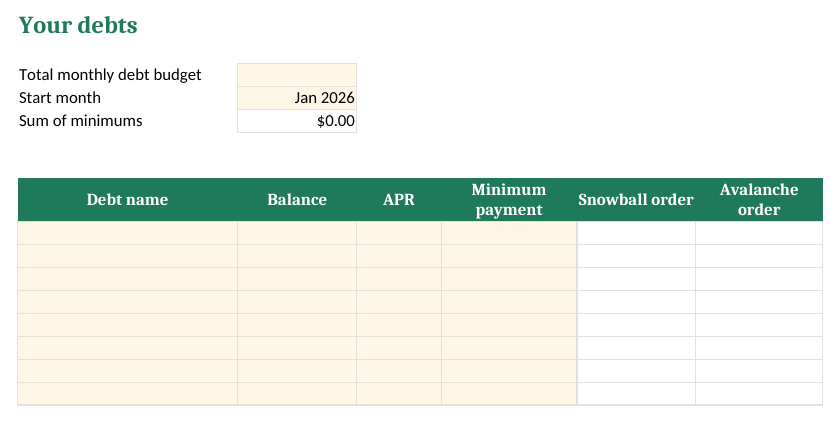
Inputs on the Debts tab:
- Total monthly debt budget: $750
- Start month: December 2026
- Personal loan: balance $2,400, APR 9.9%, minimum payment $85
- Store card: balance $3,100, APR 28.99%, minimum payment $95
- Credit card: balance $8,200, APR 22.49%, minimum payment $205
- Student loan: balance $14,500, APR 4.99%, minimum payment $155
What the Debts tab shows:
- Sum of minimums: $540 (no budget warning, since $750 is more than $540)
- Snowball order: Personal loan 1, Store card 2, Credit card 3, Student loan 4
- Avalanche order: Store card 1, Credit card 2, Personal loan 3, Student loan 4
What the Summary tab shows:
- Months to debt-free: 47 (Snowball), 46 (Avalanche)
- Debt-free month: October 2030 (Snowball), September 2030 (Avalanche)
- Total interest: $6,595.75 (Snowball), $5,982.21 (Avalanche)
- Avalanche saves: $613.54
When each debt hits zero, from the schedule tabs:
- Snowball: Personal loan in month 9 (August 2027), Store card in month 17 (April 2028), Credit card in month 31 (June 2029), Student loan in month 47 (October 2030)
- Avalanche: Store card in month 12 (November 2027), Credit card and Personal loan both in month 30 (May 2029), Student loan in month 46 (September 2030)
How to read it, step by step:
- Month 1 interest is the same under both methods, $308.67. The planner estimates it as APR divided by 12 on each balance: $19.80 on the personal loan ($2,400 x 9.9% / 12), $74.89 on the store card ($3,100 x 28.99% / 12), $153.68 on the credit card ($8,200 x 22.49% / 12), and $60.30 on the student loan ($14,500 x 4.99% / 12).
- Each month, $540 covers the four minimums and the other $210 is extra.
- Snowball sends the $210 to the personal loan, the smallest balance, even though its 9.9% rate is the second lowest. It is gone in month 9, and its payment rolls to the store card, which is paid off in month 17.
- Avalanche sends the $210 to the store card, the 28.99% debt, so it is gone in month 12. The extra then goes to the 22.49% credit card. The personal loan only gets its minimum until the credit card is paid off, and both reach zero in month 30.
- Snowball crosses its first debt off three months sooner (month 9 instead of month 12). Avalanche pays down the 28.99% and 22.49% balances sooner, which is why its total interest is $613.54 lower here and it finishes one month earlier.
- With different balances, rates or budgets, the gap could be larger, smaller, or zero, which is why the planner runs both.
Running your own comparison
If you were searching for a debt snowball calculator, the Debt Payoff Planner does the same math in a spreadsheet for snowball and avalanche at once. It takes up to 10 debts, each with a balance, APR and minimum payment, plus your monthly debt budget, and it costs $17. Interest is estimated monthly as APR divided by 12 on the balance, so your lender's actual numbers may differ.
For a walkthrough of each tab, see the debt payoff spreadsheet template guide. If you need to find room for extra payments first, the Monthly Budget tracks budgeted vs actual by category.
Sources
- CFPB, How to reduce your debt (archived blog post, July 16, 2019): descriptions of the highest interest rate and snowball methods, their tradeoffs, and the motivation-based framing for choosing
- CFPB, Resolve to take control of your debt in the new year (archived blog post): snowball may show progress quickly but may cost more in the long run
- CFPB, Reducing debt worksheet (Your Money, Your Goals toolkit): how to list debts for each method, rolling the full payment to the next debt, and the pros and cons of each
- Debt Payoff Planner template page: the up to 10 debts limit and price
- All example results: recalculated from the planner's own formulas on October 23, 2026
FAQ
What is the difference between the debt snowball and debt avalanche methods?
Both pay the minimum on every debt and send extra money to one target. Snowball targets the smallest balance first. Avalanche targets the highest interest rate first. When a target is paid off, its payment moves to the next debt in line.
Which method costs less in interest?
The CFPB says the highest interest rate method, also called avalanche, can save you money in the long run, and that with snowball you may pay more in total. In our four-debt example, avalanche cost $613.54 less in interest, but the gap depends on your balances, rates and budget.
Why would anyone choose snowball if avalanche can cost less?
The CFPB notes that with snowball you may see progress quickly, especially if you have many small debts, and that for some people this creates momentum and motivation. Some people value clearing a first debt sooner more than a lower interest total.
Do snowball and avalanche ever give the same order?
Yes. If your smallest balance also has the highest interest rate, and so on down the list, both methods target the debts in the same order and produce the same plan.
Can I compare both methods with my own numbers?
Yes. The Debt Payoff Planner takes up to 10 debts with balance, APR and minimum payment plus a monthly debt budget, then shows months to debt-free, the debt-free month and total interest for snowball and avalanche side by side.
Related templates
Debt Payoff Planner
Compare snowball and avalanche plans and see your debt-free date.
$17
View templateMonthly Budget
Plan every dollar for the month and see what is left at a glance.
$12
View template