Debt payoff spreadsheet template: plan every payment to debt-free
By Cells and Cents. Published October 22, 2026.
This is for informational purposes only and is not tax, legal, or financial advice.
A debt payoff spreadsheet template lists each debt's balance, APR and minimum payment, then shows when you will be debt-free and how much interest you will pay. Ours compares the snowball and avalanche methods side by side. In the example below, both finish in 30 months, and avalanche costs $189.50 less in interest.
Every number in this guide comes from recalculating the real planner file with made-up sample debts. Nothing here is a recommendation for your situation.
What goes into a debt payoff spreadsheet
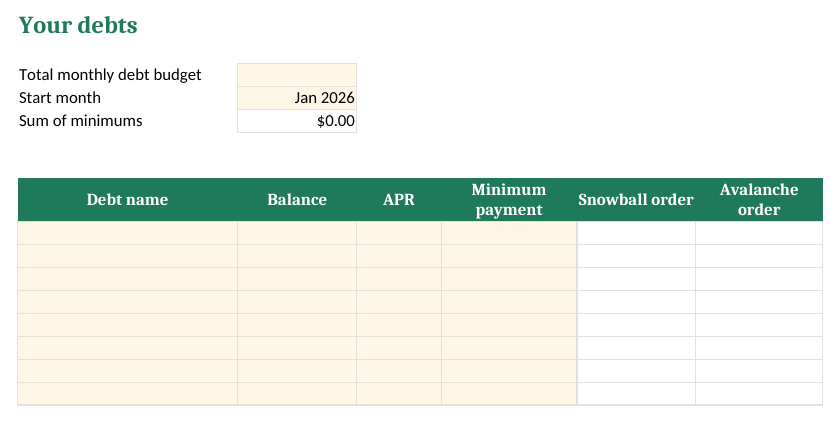
The Debt Payoff Planner asks for two kinds of input on its Debts tab:
- Your plan: a total monthly debt budget and a start month
- Your debts: up to 10 debts, each with a name, balance, APR and minimum payment
Anything in your monthly debt budget above the sum of your minimums goes to extra payments. The budget has to be at least the sum of your minimums, and the Debts tab warns you if it is not.
From there, the planner builds two month-by-month schedules and a Summary tab with the debt-free date and total interest for each method, plus a progress chart.
Snowball vs avalanche, as the planner applies them
The planner's Instructions tab defines the two methods this way:
- Snowball: extra money goes to the smallest balance first.
- Avalanche: extra money goes to the highest interest rate first.
- Both: when a debt is paid off, its minimum rolls into the next debt automatically.
Interest is estimated monthly as APR divided by 12 on the balance, so your lender's actual numbers may differ.
Worked example: three debts, $650 a month
We entered these made-up debts into a copy of the planner and recalculated it.
Inputs on the Debts tab:
- Total monthly debt budget: $650
- Start month: November 2026
- Medical bill: balance $900, APR 0%, minimum payment $50
- Credit card: balance $6,500, APR 24.99%, minimum payment $160
- Car loan: balance $9,000, APR 6.9%, minimum payment $230
What the Debts tab shows:
- Sum of minimums: $440 (no budget warning, since $650 is more than $440)
- Snowball order: Medical bill 1, Credit card 2, Car loan 3 (smallest balance first)
- Avalanche order: Credit card 1, Car loan 2, Medical bill 3 (highest APR first)
What the Summary tab shows:
- Months to debt-free: 30 (Snowball), 30 (Avalanche)
- Debt-free month: Apr 2029 (Snowball), Apr 2029 (Avalanche)
- Total interest: $2,864.32 (Snowball), $2,674.82 (Avalanche)
- Avalanche saves: $189.50
When each debt hits zero, from the schedule tabs:
- Snowball: Medical bill in month 4 (February 2027), Credit card in month 23 (September 2028), Car loan in month 30 (April 2029)
- Avalanche: Medical bill in month 18 (April 2028), Credit card in month 22 (August 2028), Car loan in month 30 (April 2029)
How to read it, step by step:
- Month 1 interest is the same under both methods, $187.11: $6,500 x 24.99% / 12 = $135.36 on the card, plus $9,000 x 6.9% / 12 = $51.75 on the car loan, plus nothing on the 0% medical bill.
- Each month, $440 covers the minimums and the other $210 is extra.
- Snowball sends the $210 to the medical bill first, the smallest balance, so it is gone in month 4. Its $50 minimum then joins the extra going to the credit card.
- Avalanche sends the $210 to the credit card first, the highest APR. The medical bill only gets its $50 minimum, so it takes until month 18.
- Paying the 24.99% card down sooner is why avalanche's total interest is lower, by $189.50 in this example.
- Both plans still finish in the same month here, April 2029. With other balances, rates or budgets, the months and the gap can be different, which is why the planner runs both.
Snowball clears a debt sooner in this example (month 4 instead of month 18). Avalanche costs less in interest. Which one suits you is a personal choice; the planner just shows both with your numbers.
Try it with your own debts
The Debt Payoff Planner does everything above for up to 10 debts. It costs $17. If you want to find room in your budget for extra payments first, the Monthly Budget tracks budgeted vs actual by category, and the free starter budget sheet is a simpler place to begin.
Sources
- Debt Payoff Planner template page: features, the up to 10 debts limit, and price
- The planner's Instructions tab (inside the .xlsx): snowball and avalanche definitions, the minimum budget rule, and interest estimated as APR / 12
- All example results: recalculated from the planner's own formulas on October 21, 2026
FAQ
What does a debt payoff spreadsheet template do?
You list each debt's balance, APR and minimum payment plus a monthly amount for debt. The spreadsheet builds a month-by-month payoff schedule and shows your debt-free date and total interest.
What is the difference between snowball and avalanche?
Snowball pays extra to the smallest balance first; avalanche pays extra to the highest APR first. Debt snowball vs avalanche compares them in detail.
How many debts can the Debt Payoff Planner handle?
Up to 10 debts, each with a balance, APR and minimum payment.
What if my monthly budget is less than my minimum payments?
The planner needs a monthly debt budget at least as large as the sum of your minimum payments, and the Debts tab warns you if it is not.
Will the interest match my lender's statements exactly?
Not necessarily. The planner estimates interest monthly as APR divided by 12 on the balance, and your lender's actual calculation may differ.
Related templates
Debt Payoff Planner
Compare snowball and avalanche plans and see your debt-free date.
$17
View templateMonthly Budget
Plan every dollar for the month and see what is left at a glance.
$12
View template