How to report self-employment income without a 1099
By Cells and Cents. Published October 29, 2026.
This is for informational purposes only and is not tax, legal, or financial advice.
Here is how to report self-employment income without a 1099: add up everything your business received from all sources, enter it as gross receipts on Schedule C, subtract your business expenses to get net profit, then carry that profit to Schedule SE. A missing 1099 does not change what you report.
A Form 1099 is a form someone else files about you. Your own records decide what goes on your return. Below: what counts as self-employment income, which self employed tax form (Schedule C) to use, when self-employment tax applies, and a worked example. Every rule comes from IRS.gov, and the sources are listed at the end.
Why you might not get a 1099
A client or platform files a Form 1099 only when a payment meets that form's own reporting rules, so some of the money you receive may never appear on one. The Instructions for Forms 1099-MISC and 1099-NEC set those rules for payers. Our guide to Form 1099-NEC explains what that form reports.
None of that changes your side of the return. The Instructions for Schedule C say: be sure to report all income attributable to your trade or business from all sources. They describe Forms 1099 as forms you may receive from people who are required to provide information to the IRS, listing amounts that may be income you received from your trade or business.
Self-employment income examples
The IRS Self-Employed Individuals Tax Center says you are generally self-employed if any of these apply to you:
- You carry on a trade or business as a sole proprietor or an independent contractor.
- You are a member of a partnership that carries on a trade or business.
- You are otherwise in business for yourself, including in a part-time business or as a gig worker.
IRS Topic 554 adds that a sole proprietor includes the member of a single member LLC that is disregarded for federal income tax purposes.
The Schedule C instructions also list kinds of business income to include on line 6 (other income), such as scrap sales, bad debts you recovered, interest on notes and accounts receivable, and prizes and awards related to your trade or business.
Business or hobby?
The same instructions say an activity qualifies as a business if your primary purpose for engaging in it is income or profit and you are involved in it with continuity and regularity. A sporadic activity, a not-for-profit activity, or a hobby does not qualify as a business. Income from a nonbusiness activity is covered in the Instructions for Schedule 1 (Form 1040), line 8j, not on Schedule C.
How to report self-employment income without a 1099, step by step
These steps follow the Instructions for Schedule C, the Instructions for Schedule SE, and Topic 554:
- Total your business income from your own records. Invoices, deposits, and payment app histories are where income without a 1099 shows up. Include amounts with and without a 1099.
- Enter gross receipts on Schedule C, line 1. If you did receive any Forms 1099-NEC, the instructions say to be sure line 1 includes the amounts properly shown on them. If the 1099-NEC totals are more than what you report on line 1, attach a statement explaining the difference.
- Subtract your business expenses. Topic 554 says you calculate net earnings by subtracting ordinary and necessary trade or business expenses from the gross income you derived from your trade or business. Our self-employed tax deductions list covers the common categories.
- Carry the net profit forward. The Schedule C instructions say individuals enter net profit or loss on line 31 and include it on Schedule 1 (Form 1040), line 3, and on Schedule SE (Form 1040), line 2.
- Figure self-employment tax on Schedule SE. Generally, 92.35% of your net earnings is subject to self-employment tax, at 12.4% for Social Security and 2.9% for Medicare (Topic 554).
- Attach the schedules. Topic 554 says to compute self-employment tax on Schedule SE and attach Schedule 2, and that you can deduct one-half of it when figuring adjusted gross income, calculated on Schedule SE (attach Schedule 1).
Do I have to pay self-employment tax?
Topic 554 says you usually must pay self-employment tax if you had net earnings from self-employment of $400 or more. The Instructions for Schedule SE say you must file Schedule SE if the amount on line 4c of Schedule SE is $400 or more, or you had church employee income of $108.28 or more.
Two related points from the IRS:
- Filing a return. The Self-Employed Individuals Tax Center says you have to file an income tax return if your net earnings from self-employment were $400 or more. Below $400, you still have to file if you meet any other filing requirement in the Form 1040 instructions.
- Income tax is separate. The tax center says self-employment tax only refers to Social Security and Medicare taxes, not income tax. Your net profit also becomes part of your income on Form 1040. For how the two differ, see self-employment tax vs income tax.
Topic 554 also notes that if you had a loss or a small amount of self-employment income, one of two optional methods may benefit you, and it points to the Schedule SE instructions to see if you qualify.
Worked example
Here is one made-up side business with no 1099s at all, run through the free self-employment tax calculator. The math comes from the same code the calculator uses (seTax in the site's calc.js), and the figures below are its exact outputs.
The situation (made up): a part-time designer was paid by several small clients during 2026, none of whom sent a 1099. Their own income log, minus business expenses, shows a net profit of $8,000.
Inputs:
- Net self-employment earnings (profit) for 2026: $8,000
- W-2 wages subject to Social Security (W-2 box 3, if any): $0
- Filing status (for additional Medicare tax): Single
Output, as the calculator shows it:
- Earnings subject to SE tax (92.35%): $7,388.00
- Amount under Social Security cap: $7,388.00
- Social Security (12.4%): $916.11
- Medicare (2.9%): $214.25
- Total self-employment tax: $1,130.36
- Deductible half of SE tax: $565.18
The steps with these numbers:
- Gross receipts from the income log go on Schedule C, line 1, even though no 1099 arrived.
- Net profit on Schedule C, line 31: $8,000. It also goes on Schedule 1, line 3, and Schedule SE, line 2.
- $8,000 x 92.35% = $7,388.00. That is $400 or more, so self-employment tax applies.
- Social Security: $7,388.00 x 12.4% = $916.11 (rounded to the cent)
- Medicare: $7,388.00 x 2.9% = $214.25 (rounded to the cent)
- Total: $916.11 + $214.25 = $1,130.36
- Deductible half: $1,130.36 x 50% = $565.18
The $400 floor in the same calculator
The calculator's 2026 settings set a minimum of $400 (Y2026.minSE in calc.js), which matches the $400 rule in Topic 554 and the Schedule SE instructions. It checks the amount after the 92.35% step, the same figure Schedule SE tests on line 4c.
Run a made-up net profit of $400 through it:
- $400 x 92.35% = $369.40
- $369.40 is under $400, so the calculator returns no self-employment tax: Social Security $0, Medicare $0, total $0, and it flags the result as below the minimum. On the page it says: "No self-employment tax: 92.35% of your net earnings is under $400."
So a net profit of exactly $400 is not enough on its own. What matters is net earnings after the 92.35% step. Even with no self-employment tax, the filing rules above can still require a return.
Self-employment tax is only part of your federal tax bill, and the calculator does not compute income tax. To plan for both, see how much to set aside for taxes when self-employed and the full walkthrough on how to calculate self-employment tax.
Keep your own income records
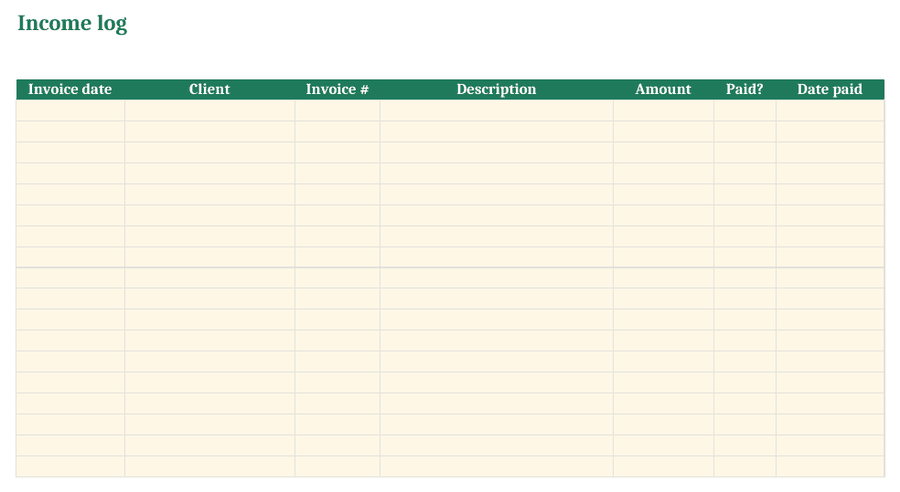
With no 1099 to check against, your own log is the record of what you earned. The Freelancer Income and Expense Tracker has an income log with client, invoice number, and paid status, an expense log with Schedule C style categories, a monthly and year-to-date profit dashboard, an unpaid invoice tracker, and a set-aside estimate for taxes. It costs $17.
The IRS tax center also says that as a self-employed individual, generally you are required to file an annual income tax return and pay estimated taxes quarterly. If that applies to you, the Quarterly Estimated Tax Tracker logs payments against each 2026 due date. The four dates, including January 15, 2027, are in our January 15, 2027 estimated tax payment guide.
Sources
- IRS: Self-Employed Individuals Tax Center
- IRS Topic no. 554, Self-employment tax
- IRS: Instructions for Schedule C (Form 1040)
- IRS: Instructions for Schedule SE (Form 1040)
FAQ
Do I have to report self-employment income if I did not get a 1099?
Yes. The Instructions for Schedule C say to be sure to report all income attributable to your trade or business from all sources. A Form 1099 is an information return from a payer, and the instructions describe Forms 1099 as amounts that may be income you received, not as the only income you report.
What tax form do self-employed people use to report income?
The IRS says to use Schedule C (Form 1040), Profit or Loss from Business (Sole Proprietorship), to report income or loss from a business you operated or a profession you practiced as a sole proprietor, or gig work performed. Social Security and Medicare taxes are reported on Schedule SE.
What are some self-employment income examples?
The IRS says you are generally self-employed if you carry on a trade or business as a sole proprietor or an independent contractor, are a member of a partnership that carries on a trade or business, or are otherwise in business for yourself, including in a part-time business or as a gig worker.
Do I have to pay self-employment tax?
IRS Topic 554 says you usually must pay self-employment tax if you had net earnings from self-employment of $400 or more. The Instructions for Schedule SE say you must file Schedule SE if the amount on line 4c is $400 or more, among other cases.
Is a hobby self-employment income?
The Instructions for Schedule C say an activity qualifies as a business if your primary purpose is income or profit and you are involved with continuity and regularity. A sporadic activity, a not-for-profit activity, or a hobby does not qualify as a business. Income from a nonbusiness activity is covered in the Instructions for Schedule 1, line 8j.
Related templates
Freelancer Income and Expense Tracker
Log invoices and expenses, see profit by month, and stay ready for tax time.
$17
View templateQuarterly Estimated Tax Tracker
Track 2026 estimated payments against due dates so nothing sneaks up on you.
$17
View template