Home / Guides / When are quarterly taxes due? 2026 dates, including January 15, 2027
When are quarterly taxes due? 2026 dates, including January 15, 2027
By Cells and Cents. Published October 16, 2026. Updated November 16, 2026.
This is for informational purposes only and is not tax, legal, or financial advice.
When are quarterly taxes due? The quarterly tax dates for 2026 estimated payments are April 15, June 15 and September 15, 2026, and January 15, 2027. The January payment covers income from September 1 to December 31, 2026. You can skip it if you file your 2026 return by February 1, 2027 and pay the entire balance due.
Every rule below comes from IRS.gov. The sources are linked in each section and listed at the end.
Plan the month around your January payment
A one-month .xlsx budget with budgeted vs actual columns, automatic totals, money left over, and your savings rate. You also get our weekly email with new templates and tips; confirm by email, unsubscribe anytime.
Instant download. No spam, unsubscribe anytime.
Want the full Monthly Budget template?
Plan every dollar for the month and see what is left at a glance. Includes 12 monthly tabs plus a yearly summary, budgeted vs actual with automatic differences, customizable categories. $12.
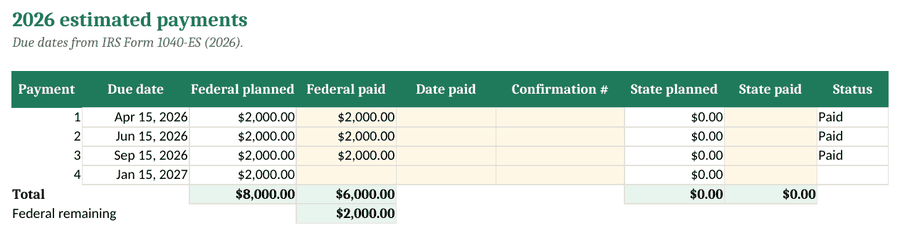
For estimated tax, the IRS splits the year into four payment periods, each with its own due date (Form 1040-ES, IRS estimated tax FAQ). The table at the top of this page lists those periods and dates.
The periods are not the same length, so "quarterly" is a nickname more than a description. If a due date falls on a Saturday, Sunday, or legal holiday, a payment made on the next business day is on time. January 15, 2027 is a Friday.
Do you need to make estimated payments at all?
According to the IRS estimated tax FAQ, you generally must make estimated payments if both of these are true:
You expect to owe at least $1,000 for the year after subtracting withholding and refundable credits.
You expect your withholding and refundable credits to be less than the smaller of 90% of the tax on your current year's return, or a prior-year amount. The prior year's return must cover all 12 months.
The prior-year amount depends on your prior-year adjusted gross income (AGI), per the IRS estimated tax FAQ:
Prior-year AGI of $150,000 or less ($75,000 or less if married filing separately): 100% of the tax shown on your prior year's return
Prior-year AGI over $150,000 (over $75,000 if married filing separately): 110% of the tax shown on your prior year's return
For the January 15, 2027 payment, the prior year is 2025, so it is your 2025 AGI that decides between 100% and 110%.
Estimated tax pays self-employment tax as well as income tax. If you also have a W-2 job, the IRS notes you can ask your employer to withhold more with a new Form W-4 instead (IRS: Estimated taxes).
Worked example: what is left for January 15
With three dates already behind us, the question that matters now is what is left for January 15. To see it, compare your annual target with what you have already paid.
The IRS says taxpayers should generally pay estimated tax in four equal amounts (Topic 306). By January, most of the year is already behind you, so the useful question is what is left, given what you have already paid.
Expected total 2026 tax (income tax plus SE tax): $12,000
Total tax on your 2025 return (optional): $8,000
My 2025 AGI was over $150,000 ($75,000 if married filing separately): not checked
Expected 2026 withholding and refundable credits: $0
Estimated payments already made for 2026: $6,000 ($2,000 each on April 15, June 15 and September 15, 2026)
Plan for: Safe harbor minimum
Plan starting from: October 16, 2026
Output, as the calculator shows it:
Annual target: $8,000.00
Required from estimated payments: $8,000.00
Remaining to pay: $2,000.00
April 15, 2026: passed
June 15, 2026: passed
September 15, 2026: passed
January 15, 2027: $2,000.00
How it gets there, step by step:
90% of expected 2026 tax: $12,000 x 90% = $10,800
100% of 2025 tax: $8,000 (100%, not 110%, because the 2025 AGI box is not checked)
The safe harbor target is the smaller of the two: $8,000
Remaining to pay: $8,000 minus $6,000 already paid ($2,000 each on April 15, June 15 and September 15, 2026) = $2,000
Only one due date is left, so the full $2,000 goes on the January 15, 2027 line
In this example, each $2,000 payment was one quarter of the $8,000 target, so the payments stayed on pace all year.
The same example in the tracker
The worked example below, entered in the Quarterly Estimated Tax Tracker. The January 15, 2027 status cell stays blank until that date passes.
The Quarterly Estimated Tax Tracker does not let you type in expected 2026 tax. It helps you plan set-asides at the rate you enter, working from the income and expenses on its Estimate tab. To reach the same $12,000 in the tracker, we entered these made-up numbers:
Estimate tab, income for each of the four payment periods: $13,000
Estimate tab, expenses: $1,135 (January 1 to March 31), $1,100 (April 1 to May 31), $1,150 (June 1 to August 31), $1,150 (September 1 to December 31)
Estimate tab, W-2 wages: $0
Estimate tab, estimated federal income tax rate on profit: 12% (the template's starting value; your own rate will differ)
Estimate tab, estimated state income tax rate on profit: 0%, to keep this example federal only
Safe Harbor tab, 2025 total tax: $8,000, with "2025 AGI over $150,000 ($75,000 MFS)?" set to No
Payments tab, federal paid: $2,000 each on April 15, June 15 and September 15, 2026
With those entries, the tracker shows:
Estimate tab: profit $47,465.00, self-employment tax $6,706.59, income tax set-aside (at the rate you enter) $5,293.40, estimated total federal tax $12,000.00 (the cell rounds to the cent)
Safe Harbor tab: 90% of 2026 tax $10,800.00, prior-year safe harbor $8,000.00, required annual payment $8,000.00, per quarter $2,000.00
Payments tab: $2,000.00 planned on each due date, $8,000.00 total planned, $6,000.00 paid, $2,000.00 federal remaining
Payments tab status: "Paid" for April 15, June 15 and September 15, 2026. The January 15, 2027 status cell is blank until that date passes. After that, it shows "Due" if no payment is logged, "Partial" if you log less than planned, and "Paid" once the payment is logged.
That matches the calculator's January 15, 2027 line of $2,000.00. The screenshot above shows the Payments tab with these entries.
What changes if you plan for the full amount
Same calculator inputs with "Plan for" set to 100% of expected 2026 tax: the annual target becomes $12,000.00, and the January 15, 2027 line becomes $6,000.00 ($12,000 minus $6,000 paid). That plan covers the full expected tax instead of the safe harbor minimum. Which approach fits depends on your situation. The IRS worksheets in Form 1040-ES or a tax professional can help you decide.
What this example does not show: a penalty amount. If earlier payments came in short or late, catching up in January can still leave a penalty for earlier quarters, and the IRS can charge a penalty even if you are due a refund (IRS: Estimated taxes). The IRS uses Form 2210 to figure it (Topic 306).
Can you skip the January 15 payment?
Yes, in one specific case. Per Form 1040-ES (2026), you do not have to make the January 15, 2027 payment if you file your 2026 tax return by February 1, 2027 and pay the entire balance due with it.
Two IRS documents print different dates for this. Publication 505 (2026) says you don't need to make the January 15 payment if you file your 2026 Form 1040 or 1040-SR "by January 31, 2027" and pay the rest of the tax you owe. The 2026 Form 1040-ES says February 1, 2027. January 31, 2027 is a Sunday, and February 1 is the next business day, which matches the IRS rule for due dates that fall on a weekend.
Your IRS online account, which also shows your payment history
Direct Pay from a bank account
By phone, or from your phone with the IRS app
By mail with a Form 1040-ES voucher. A mailed payment counts as paid on its U.S. postmark date.
You also do not have to wait for the due date. The IRS says you can pay weekly, biweekly, or monthly, as long as enough is paid by the end of the period. If your income estimate turns out too high or too low, the IRS suggests completing another Form 1040-ES worksheet and refiguring for the next payment.
Keep a record of what you paid
You will need your payment dates and amounts at filing time. The Quarterly Estimated Tax Tracker ($17) has the 2026 due dates prefilled. It includes a payment log with confirmation numbers and federal and state columns. Expected 2026 tax is not typed in. The tracker helps you plan set-asides at the rate you enter, using the income and expenses you enter for each payment period on its Estimate tab, then the Safe Harbor tab turns that into a planned amount for each due date. If you would rather start with the free tools, the quarterly estimated tax calculator and the self-employment tax calculator need no signup.
The four 2026 estimated tax payments are due April 15, June 15 and September 15, 2026, and January 15, 2027. The January payment covers income from September 1 to December 31, 2026.
Can I skip the January 15, 2027 estimated tax payment?
You do not have to make it if you file your 2026 return by February 1, 2027 and pay the entire balance due with the return.
What if January 15 falls on a weekend?
A payment made on the next day that is not a Saturday, Sunday, or legal holiday is on time. In 2027, January 15 is a Friday.
Do I need to make estimated payments if I expect to owe less than $1,000?
Generally, the requirement applies when you expect to owe at least $1,000 after subtracting withholding and refundable credits.
Can I make smaller payments more often instead of one big January payment?
Yes. The IRS says you can pay weekly, biweekly, or monthly, as long as enough is paid by the end of the period.
Does paying the full amount in January erase a penalty from earlier quarters?
Not necessarily. The IRS generally expects four equal payments, and Form 2210 is used to see whether you owe a penalty. If your income came in unevenly, the IRS notes the annualized installment method may lower or remove the penalty.
Related templates
Small business
Quarterly Estimated Tax Tracker
Track 2026 estimated payments against due dates so nothing sneaks up on you.