Form 1099-NEC explained for freelancers
By Cells and Cents. Published October 28, 2026.
This is for informational purposes only and is not tax, legal, or financial advice.
Form 1099-NEC is the IRS information return a business uses to report nonemployee compensation, such as fees it paid you as a freelancer. For 2026 payments, the reporting threshold is $2,000 per payee, the amount goes in box 1a, and the payer must send your copy and file it with the IRS by January 31.
If you searched for the self employed tax form 1099, this is usually the one clients send you. Below: what each box means, when it arrives, and how to check it against your own records. Every rule comes from IRS.gov, and the sources are listed at the end.
What Form 1099-NEC is
The IRS page About Form 1099-NEC says to use Form 1099-NEC to report nonemployee compensation. As a freelancer, you are usually the recipient, not the filer: each client that paid you enough during the year in the course of its trade or business files one and sends you a copy.
According to the Instructions for Forms 1099-MISC and 1099-NEC (12/2026), a business must generally report a payment as nonemployee compensation when all four of these are true:
- The payment was made to someone who is not its employee.
- The payment was for services in the course of its trade or business.
- The payment was made to an individual, partnership, estate, or, in some cases, a corporation.
- It paid that payee at least $2,000 during the year.
The instructions also say personal payments are not reportable. Only payments made in the course of a trade or business go on the form.
The 2026 threshold is $2,000
The instructions say: for tax years beginning after 2025, the minimum threshold amount for reporting certain payments required to be reported on certain information returns increased to $2,000 and may be adjusted for inflation beginning in calendar year 2027. Box 1a is where a payer enters nonemployee compensation of $2,000 or more.
The same instructions say these December 2026 revisions are used to file 2026 information with the IRS in early 2027, and not for prior years. So for work you are paid for in 2026, a client generally files a Form 1099-NEC for you only if it paid you at least $2,000 during the year.
When Form 1099-NEC is due
Per the instructions, a payer must file Form 1099-NEC on or before January 31, on paper or electronically, and must also furnish the payee statement to you by January 31. If the date falls on a Saturday, Sunday, or legal holiday in the District of Columbia or where the return is filed, the due date is the next business day.
For 2026 forms, January 31, 2027 is a Sunday, so under that rule the due date moves to the next business day, Monday, February 1, 2027.
What each box on Form 1099-NEC means
The December 2026 revision added new boxes, so the main amount is now in box 1a. From the instructions:
- Box 1a, Nonemployee compensation: nonemployee compensation of $2,000 or more, including fees, commissions, prizes and awards for services performed as a nonemployee.
- Box 1b, Cash tips: the total amount designated as cash tips included in box 1a.
- Box 1c, Treasury Tipped Occupation Code(s): up to two codes for the payee's tipped occupation(s).
- Box 1d, Overtime compensation: the total qualified overtime compensation included in box 1a.
- Box 2, Payer made direct sales totaling $5,000 or more: payers may use it to report these sales of consumer products for resale.
- Box 3, Excess golden parachute payments.
- Box 4, Federal income tax withheld: backup withholding, for example when a payee has not furnished a TIN.
- Boxes 5 to 7, State information: state tax withheld, the state and payer's state ID, and the state payment amount. These need not be completed for the IRS.
For most freelancers, box 1a is the number that matters.
What is not on a 1099-NEC
The instructions list payments that do not go on Form 1099-NEC. Two that often explain a mismatch for freelancers:
- Card and third-party network payments. Payments made with a credit card or payment card and certain other types of payments, including third-party network transactions, must be reported on Form 1099-K by the payment settlement entity and are not subject to reporting on Form 1099-NEC.
- Payments to most corporations. Generally, payments to a corporation (including an LLC treated as a C or S corporation) are not required on Form 1099-NEC, with exceptions such as attorneys' fees.
The instructions also note that some payments do not have to be reported on Form 1099-NEC although they may be taxable to the recipient.
Worked example: reconciling three 1099-NECs with your tracker
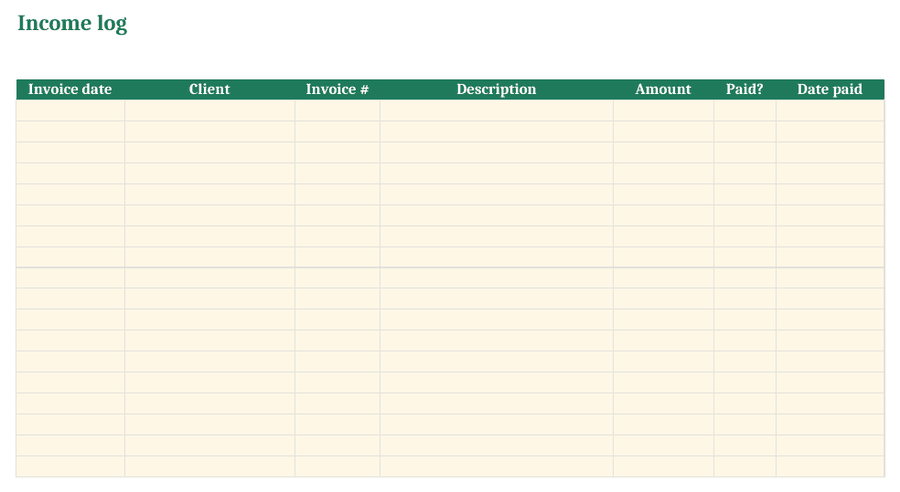
Here is one made-up freelancer with three made-up clients for 2026. The invoices are logged on the Income tab of the Freelancer Income and Expense Tracker, which has columns for invoice date, client, invoice number, description, amount, paid status and date paid. The totals below were recalculated from the workbook itself.
Income tab (made-up rows):
- Feb 10, 2026: Harbor Lane Design, INV-101, brand refresh, $3,200.00, Paid: Yes, paid Feb 24, 2026
- Mar 5, 2026: Maple Row Media, INV-102, podcast show notes, $2,500.00, Paid: Yes, paid Mar 20, 2026
- Apr 8, 2026: Copper Kettle Co., INV-103, website build, $6,000.00, Paid: Yes, paid Apr 30, 2026
- Jun 2, 2026: Harbor Lane Design, INV-104, packaging design, $4,800.00, Paid: Yes, paid Jun 16, 2026
- Aug 11, 2026: Copper Kettle Co., INV-105, website updates paid by credit card, $1,250.00, Paid: Yes, paid Aug 12, 2026
- Dec 14, 2026: Maple Row Media, INV-106, episode artwork, $1,900.00, Paid: No
Expenses tab (made-up rows): software and subscriptions $1,140.00, office expense $385.00, phone and internet $720.00.
Dashboard, year to date (as the workbook calculates it):
- Income received: $17,750.00
- Expenses: $2,245.00
- Profit: $15,505.00
- Unpaid invoices: $1,900.00 (1 invoice)
The 1099-NECs that arrive (box 1a, made-up):
- Harbor Lane Design: $8,000.00
- Maple Row Media: $2,500.00
- Copper Kettle Co.: $6,000.00
- Total of the three forms: $16,500.00
Reconciling client by client:
- Harbor Lane Design: paid invoices INV-101 ($3,200.00) plus INV-104 ($4,800.00) = $8,000.00. That matches box 1a.
- Maple Row Media: only INV-102 ($2,500.00) was paid in 2026. INV-106 ($1,900.00) is marked No, so the tracker leaves it out of income received and shows it under unpaid invoices. Box 1a of $2,500.00 matches the paid amount.
- Copper Kettle Co.: INV-103 ($6,000.00) was paid directly, which matches box 1a. INV-105 ($1,250.00) was paid by credit card, and the IRS instructions say card payments are reported on Form 1099-K, not Form 1099-NEC.
- Explain the gap: income received on the tracker ($17,750.00) minus the three forms ($16,500.00) = $1,250.00, which is exactly the card-paid INV-105.
Once each difference has a reason, the tracker's paid income, not the sum of your forms, is the gross income figure in this example. IRS Topic 554 says you calculate net earnings by subtracting ordinary and necessary trade or business expenses from the gross income you derived from your trade or business.
From net profit to self-employment tax
The tracker's year-to-date profit of $15,505.00 then goes into the free self-employment tax calculator.
Inputs:
- Net self-employment earnings (profit) for 2026: $15,505
- W-2 wages subject to Social Security (W-2 box 3, if any): $0
- Filing status (for additional Medicare tax): Single
Output, as the calculator shows it:
- Earnings subject to SE tax (92.35%): $14,318.87
- Amount under Social Security cap: $14,318.87
- Social Security (12.4%): $1,775.54
- Medicare (2.9%): $415.25
- Total self-employment tax: $2,190.79
- Deductible half of SE tax: $1,095.39
The steps with these numbers:
- $15,505 x 92.35% = $14,318.87 (rounded to the cent)
- Social Security: $14,318.87 x 12.4% = $1,775.54
- Medicare: $14,318.87 x 2.9% = $415.25
- Total: $1,775.54 + $415.25 = $2,190.79
- Deductible half: half of the unrounded total ($2,190.7867 / 2) = $1,095.39
The 12.4% and 2.9% rates, the 92.35% factor, and the deduction for one-half of self-employment tax all come from Topic 554. Self-employment tax is only part of your federal tax bill, and the calculator does not compute income tax.
Where 1099-NEC income shows up on your self-employed tax form 1040
The instructions say amounts paid to individuals that are reportable in box 1a are generally subject to self-employment tax. Topic 554 adds:
- You usually must pay self-employment tax if you had net earnings from self-employment of $400 or more.
- If you are required to pay it, attach Schedule SE (Form 1040) and Schedule 2 (Form 1040) to your Form 1040, 1040-SR, or 1040-NR.
- When figuring adjusted gross income, you can deduct one-half of the self-employment tax, calculated on Schedule SE.
The instructions also caution payers to report each payment in the proper box because the IRS uses this information to determine whether the recipient has properly reported the payment. Checking each form against your own records before you file is one way to catch a wrong or missing form early. If a form looks wrong, a tax professional can tell you how to handle it for your situation.
Keep your 1099 records in one place
A reconciliation like the one above is faster when every invoice is already logged. The Freelancer Income and Expense Tracker has an income log with client, invoice number, and paid status, an expense log with Schedule C style categories, a monthly and year-to-date profit dashboard, an unpaid invoice tracker, and a set-aside estimate for taxes. It costs $17. Income from these forms also feeds estimated tax. The 2026 estimated payment dates, including January 15, 2027, are in our January 15, 2027 estimated tax payment guide.
Sources
- IRS: About Form 1099-NEC, Nonemployee Compensation
- IRS: Instructions for Forms 1099-MISC and 1099-NEC (12/2026)
- IRS Topic no. 554, Self-employment tax
FAQ
What is Form 1099-NEC used for?
The IRS says to use Form 1099-NEC to report nonemployee compensation. A business files it for each person it paid at least $2,000 during the year for services performed by someone who is not its employee.
What is the Form 1099-NEC threshold for 2026?
The IRS instructions say that for tax years beginning after 2025, the minimum threshold for reporting these payments increased to $2,000, and it may be adjusted for inflation beginning in calendar year 2027. Box 1a is for nonemployee compensation of $2,000 or more.
When is Form 1099-NEC due?
The payer must furnish the statement to the recipient and file with the IRS by January 31. If that date falls on a Saturday, Sunday, or legal holiday, the due date is the next business day.
Why does my 1099-NEC total not match my own income records?
Common reasons include invoices not yet paid by year end, payments made by credit card (which are reported on Form 1099-K instead), and clients who paid you less than $2,000 for the year. Compare each form against your paid invoices client by client.
Is 1099-NEC income subject to self-employment tax?
The IRS instructions say amounts paid to individuals that are reportable in box 1a are generally subject to self-employment tax. Self-employment tax is figured on Schedule SE and attached, with Schedule 2, to Form 1040.
Related templates
Freelancer Income and Expense Tracker
Log invoices and expenses, see profit by month, and stay ready for tax time.
$17
View templateQuarterly Estimated Tax Tracker
Track 2026 estimated payments against due dates so nothing sneaks up on you.
$17
View template