Self-employed tax deductions: a Schedule C category list
By Cells and Cents. Published October 24, 2026.
This is for informational purposes only and is not tax, legal, or financial advice.
Self-employed tax deductions are business expenses that are both ordinary and necessary, according to the IRS. Ordinary means common and accepted in your field of business, and necessary means helpful and appropriate for your business. Sole proprietors list them on Schedule C, Part II. Half of self-employment tax is a separate deduction when figuring AGI.
The descriptions below stay close to the IRS's wording. The current editions are the 2025 Instructions for Schedule C and Publication 334 (2025), which cover 2025 returns, and the 2026 Schedule C form. The line numbers this guide cites are unchanged from the 2025 form. Check the instructions and Publication 334 again when the 2026 versions are posted.
The rule behind every deduction
Per Publication 334, to be deductible, a business expense must be both ordinary and necessary. An expense you would like to deduct but that is not on the list below can still go on Schedule C, Part V (line 48), which the instructions describe as all ordinary and necessary business expenses not deducted elsewhere on Schedule C.
Line 48 also lists what not to include there: the cost of business equipment or furniture, replacements or permanent improvements to property, personal, living, and family expenses, and charitable contributions. You also cannot deduct fines or penalties paid to a government for violating any law (Instructions for Schedule C).
Self-employed tax deductions list, by Schedule C line
These are the 18 expense categories in our Freelancer Income and Expense Tracker, each matched to the Schedule C line and IRS wording that fit it. The line names come from the Schedule C form; the descriptions come from the Instructions for Schedule C unless noted.
- Advertising: line 8, "Advertising." Publication 334 lists advertising among the other expenses you may be able to deduct.
- Car and truck: line 9, "Car and truck expenses." You can deduct the actual expenses of operating your car or truck or take the standard mileage rate.
- Contract labor: line 11, "Contract labor." Payments to persons you do not treat as employees (for example, independent contractors) for services performed for your business. Do not include salaries and wages paid to your employees.
- Insurance: line 15, "Insurance (other than health)." Premiums paid for business insurance. Do not deduct premiums for a policy that pays for your lost earnings due to sickness or disability.
- Legal and professional: line 17, "Legal and professional services." Fees charged by accountants and attorneys that are ordinary and necessary expenses directly related to operating your business, including fees for tax advice related to your business and for preparing its tax forms.
- Office expense: line 18, "Office expense." Your expenses for office supplies and postage.
- Rent or lease: lines 20a and 20b. Line 20a is the business portion of your rental cost for vehicles, machinery, or equipment. Line 20b is amounts paid to rent or lease other property, such as office space in a building.
- Repairs: line 21, "Repairs and maintenance." The cost of incidental repairs and maintenance that do not add to the property's value or appreciably prolong its life. Do not deduct the value of your own labor.
- Supplies: line 22, "Supplies." In most cases, materials and supplies only to the extent you actually consumed and used them in your business during the tax year.
- Taxes and licenses: line 23, "Taxes and licenses." Includes state and local sales taxes imposed on you as the seller of goods or services, real estate and personal property taxes on business assets, and licenses and regulatory fees for your business paid each year to state or local governments.
- Travel: line 24a, "Travel." Lodging and transportation connected with overnight travel for business while away from your tax home. Meals do not go on this line.
- Meals (50%): line 24b, "Deductible meals." Your deductible business meal expenses are a percentage of your actual business meal expenses or standard meal allowance, and in most cases the percentage is 50%, if the IRS conditions for business meals are met.
- Utilities: line 25, "Utilities." Utility expenses only for your trade or business.
- Phone and internet: line 25 rules for local telephone service. If you used your home phone for business, do not deduct the base rate (including taxes) of the first phone line into your residence, but you can deduct additional costs you incurred for business above it. The IRS pages we checked do not separately address home internet.
- Software and subscriptions: no named line. The IRS pages we checked do not name software subscriptions. Expenses that are ordinary and necessary and not deducted elsewhere go in Part V, line 48.
- Education: no named line. Publication 334 lists education expenses among the other expenses you may be able to deduct.
- Bank and payment fees: no named line. Publication 334 lists bank fees among the other expenses you may be able to deduct. It does not name payment processor fees.
- Other: Part V, line 48, carried to line 27b. All ordinary and necessary business expenses not deducted elsewhere on Schedule C, with each type and amount listed separately.
Two IRS items are not tracker categories:
- Business use of your home: line 30. You may be able to deduct certain expenses for business use of your home, subject to limitations, using Form 8829 or the simplified method (Instructions for Schedule C).
- The deductible half of self-employment tax. When figuring adjusted gross income, you can deduct one-half of the self-employment tax, calculated on Schedule SE (Topic 554). It is not a Schedule C expense.
Worked example: sorting one month of sample expenses
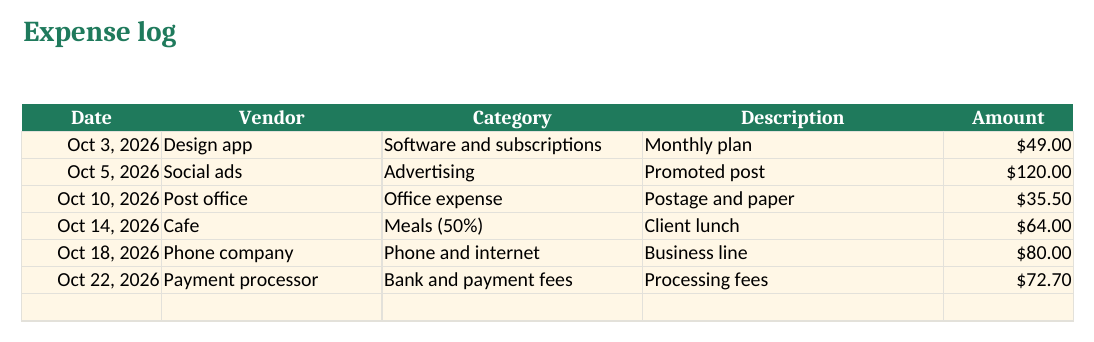
We entered six made-up October 2026 expenses on the Expenses tab of a copy of the tracker (shown in the screenshot at the top) and recalculated it.
Inputs on the Expenses tab:
- Oct 3, Design app, Software and subscriptions: $49.00
- Oct 5, Social ads, Advertising: $120.00
- Oct 10, Post office, Office expense: $35.50
- Oct 14, Cafe, Meals (50%): $64.00
- Oct 18, Phone company, Phone and internet: $80.00
- Oct 22, Payment processor, Bank and payment fees: $72.70
What the Dashboard shows (category year totals for 2026):
- Advertising: $120.00
- Office expense: $35.50
- Meals (50%): $64.00
- Software and subscriptions: $49.00
- Phone and internet: $80.00
- Bank and payment fees: $72.70
- October expenses: $421.20
Matching them to Schedule C:
- Advertising, $120.00: line 8
- Office expense, $35.50: line 18 (office supplies and postage)
- Meals, $64.00: line 24b. The tracker records the full amount you paid and does not apply the 50% limit. Where the 50% applies, the meal amount for line 24b is $64.00 x 50% = $32.00.
- Phone and internet, $80.00: a business line fits the line 25 telephone rules above; check how the IRS treats the internet part for your situation
- Software and subscriptions, $49.00, and bank and payment fees, $72.70: no named line, so Part V, line 48, if they are ordinary and necessary for your business
The tracker's Instructions tab says its categories loosely follow Schedule C. A tax professional can confirm how your own expenses should be reported.
Second example: the deductible half of self-employment tax
The half-of-SE-tax deduction comes from a different calculation. One example run through the free self-employment tax calculator, with made-up inputs:
- Inputs: Net self-employment earnings (profit) for 2026: $60,000; W-2 wages subject to Social Security (W-2 box 3, if any): $0; Medicare wages (W-2 box 5, optional): blank; Filing status: Single
- Output: Total self-employment tax: $8,477.73; Deductible half of SE tax: $4,238.87
That $4,238.87 is subtracted when figuring adjusted gross income, not listed on Schedule C (Topic 554).
Keep the records as you go
The Freelancer Income and Expense Tracker has an expense log with Schedule C style categories, a monthly and year-to-date profit dashboard, and an unpaid invoice tracker. It costs $17. Deductions change the profit that feeds your estimated payments. For the 2026 due dates, including January 15, 2027, see our January 15, 2027 estimated tax payment guide.
Sources
- IRS 2025 Instructions for Schedule C (Form 1040)
- IRS Schedule C (Form 1040), 2026
- IRS Publication 334 (2025), Tax Guide for Small Business
- IRS Topic no. 554, Self-employment tax
FAQ
What counts as a self-employed tax deduction?
Publication 334 says that to be deductible, a business expense must be both ordinary and necessary. An ordinary expense is common and accepted in your field of business, and a necessary expense is helpful and appropriate for your business.
Where do self-employed business expenses go on the tax return?
Sole proprietors report business expenses on Schedule C (Form 1040), Part II. Expenses that do not fit another line go in Part V, line 48, and the total carries to line 27b.
Can I deduct the full cost of business meals?
Usually not. The Schedule C instructions say deductible business meal expenses are a percentage of the actual cost, and in most cases the percentage is 50%, if the IRS conditions for business meals are met.
Can I deduct my home phone?
The Schedule C instructions say not to deduct the base rate (including taxes) of the first phone line into your residence, but you can deduct additional costs you incurred for business above that base rate, such as the business share of a second line.
Is half of self-employment tax a business expense on Schedule C?
No. IRS Topic 554 says you can deduct one-half of self-employment tax when figuring adjusted gross income, and you figure that deduction on Schedule SE, not as a Schedule C expense.
Related template
Freelancer Income and Expense Tracker
Log invoices and expenses, see profit by month, and stay ready for tax time.
$17
View template