How much to set aside for taxes when self-employed
By Cells and Cents. Published October 23, 2026.
This is for informational purposes only and is not tax, legal, or financial advice.
How much to set aside for taxes when self-employed comes down to two parts. Self-employment tax is 12.4% plus 2.9% on 92.35% of your net earnings, which works out to 14.13% of profit if you have no W-2 wages and 92.35% of your profit is under the Social Security cap. Income tax comes on top and depends on your whole return, so the IRS Form 1040-ES worksheet is the way to estimate it.
Every tax rule below comes from IRS.gov, and every number in the examples comes from our calculator code or a recalculated copy of our tracker. The sources are listed at the end.
Part 1: self-employment tax, which you can calculate exactly
From IRS Topic 554:
- You usually must pay self-employment tax if you had net earnings from self-employment of $400 or more.
- Generally, the amount subject to it is 92.35% of your net earnings.
- The rate is 12.4% for Social Security and 2.9% for Medicare.
- When figuring adjusted gross income, you can deduct one-half of the self-employment tax.
For 2026, the maximum amount of wages and net earnings from self-employment subject to Social Security tax is $184,500 (Form 1040-ES (2026)). Medicare has no cap, and a separate 0.9% additional Medicare tax applies above $200,000 for single filers (combined Medicare wages and self-employment income) (Topic 560).
Worked example: self-employment tax on $60,000 of profit
Here is one example run through the free self-employment tax calculator. The numbers are made up for illustration.
Inputs:
- Net self-employment earnings (profit) for 2026: $60,000
- W-2 wages subject to Social Security (W-2 box 3, if any): $0
- Medicare wages (W-2 box 5, optional): left blank
- Filing status (for additional Medicare tax): Single
Output, as the calculator shows it:
- Earnings subject to SE tax (92.35%): $55,410.00
- Amount under Social Security cap: $55,410.00
- Social Security (12.4%): $6,870.84
- Medicare (2.9%): $1,606.89
- Total self-employment tax: $8,477.73
- Deductible half of SE tax: $4,238.87
As a share of profit: $8,477.73 divided by $60,000 is 14.13% (rounded). That is the same as 92.35% x (12.4% + 2.9%), so it holds whenever you have no W-2 wages, the full 92.35% amount is under the Social Security cap and over the $400 floor, and no additional Medicare tax applies. Above the cap, the share drops, because the 12.4% part stops.
That 14.13% covers self-employment tax only. It is not a full set-aside percentage.
Part 2: income tax, which depends on your whole return
The IRS says estimated tax is used to pay not only income tax but other taxes such as self-employment tax (IRS: Estimated taxes). Our tools do not compute income tax, and this guide does not estimate it, because it depends on your other income, deductions and credits.
To figure your total estimated tax, Form 1040-ES (2026) says you will need the 2026 Estimated Tax Worksheet, its instructions, the 2026 Tax Rate Schedules, and your 2025 return as a guide. Two points connect it to the example above:
- The worksheet includes self-employment tax on its own line, figured with the Self-Employment Tax and Deduction Worksheet.
- The deductible half of self-employment tax ($4,238.87 in the example) is subtracted when figuring your expected adjusted gross income.
If this is your first year self-employed, the IRS says you will need to estimate the income you expect to earn, and to refigure with another Form 1040-ES worksheet if your estimate turns out too high or too low (Self-employed individuals tax center).
Turning it into a set-aside in the tracker
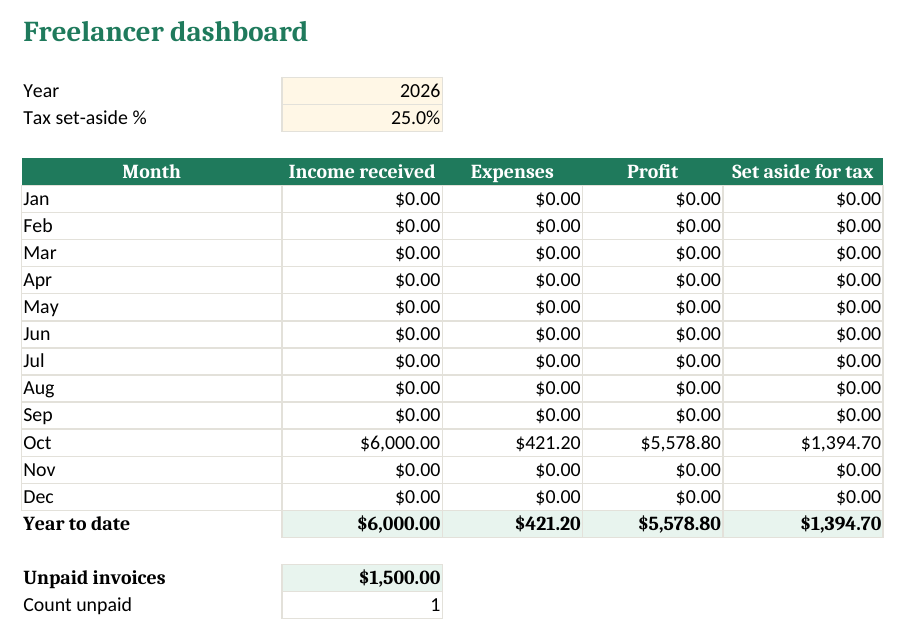
Once you have picked a percentage from your own estimate, the Freelancer Income and Expense Tracker applies it for you. Its Dashboard has a Tax set-aside % cell, and each month's "Set aside for tax" is that month's profit (if positive) times the percentage. Because the set-aside is based on profit, logging every expense matters, and our Schedule C list of self-employed tax deductions shows which categories the IRS recognizes.
Example: one month of sample data
We entered made-up sample data in a copy of the tracker and recalculated it:
- Income tab: $2,500 from Client A and $3,500 from Client B, both marked Paid in October 2026, plus a $1,500 invoice to Client C marked unpaid
- Expenses tab: six October expenses totaling $421.20
- Dashboard: Tax set-aside % left at the template's starting value, 25.0%
What the Dashboard shows:
- October income received: $6,000.00 (unpaid invoices are not counted)
- October expenses: $421.20
- October profit: $5,578.80
- October set aside for tax: $1,394.70 ($5,578.80 x 25%)
- Unpaid invoices: $1,500.00, count 1
The 25% is only a placeholder in the template. Replace it with the percentage that fits your own estimate. The tracker costs $17.
From set-aside to payments
Setting money aside is not the same as paying it. You generally must make estimated payments for 2026 if you expect to owe at least $1,000 after withholding and refundable credits, and your withholding and credits will be less than the smaller of 90% of your 2026 tax or 100% of your 2025 tax (110% if your 2025 AGI was over $150,000, or $75,000 if married filing separately) (Form 1040-ES (2026)). The free quarterly estimated tax calculator splits what is left across the remaining 2026 due dates. Those due dates, including January 15, 2027, are listed in our 2026 quarterly tax dates guide.
Sources
- IRS Topic no. 554, Self-employment tax
- IRS Topic no. 560, Additional Medicare tax
- IRS Form 1040-ES, Estimated Tax for Individuals (2026)
- IRS: Estimated taxes
- IRS Self-employed individuals tax center
FAQ
How much should I set aside for taxes when self-employed?
There is no single percentage. Self-employment tax can be calculated exactly from your net earnings. Income tax depends on your whole return, and the IRS Form 1040-ES worksheet is the tool for estimating your total.
How much is self-employment tax in 2026?
IRS Topic 554 gives the rate as 12.4% for Social Security plus 2.9% for Medicare, generally applied to 92.35% of net earnings. For 2026, Form 1040-ES says the maximum amount of wages and net earnings subject to Social Security tax is $184,500.
Is the set-aside only for self-employment tax?
No. The IRS says estimated tax is used to pay income tax as well as other taxes such as self-employment tax, so a set-aside that covers only self-employment tax will usually fall short.
What if my income changes during the year?
The IRS says that if your estimate was too high or too low, you can complete another Form 1040-ES worksheet and refigure your estimated tax for the next quarter.
Does the tracker tell me what percentage to use?
No. You enter the percentage yourself in the Dashboard's Tax set-aside % cell. The template starts at 25%, which is a placeholder, not advice.
Related templates
Freelancer Income and Expense Tracker
Log invoices and expenses, see profit by month, and stay ready for tax time.
$17
View templateQuarterly Estimated Tax Tracker
Track 2026 estimated payments against due dates so nothing sneaks up on you.
$17
View template