How to Calculate Quarterly Taxes: The Form 1040-ES Worksheet
By Cells and Cents. Published November 18, 2026.
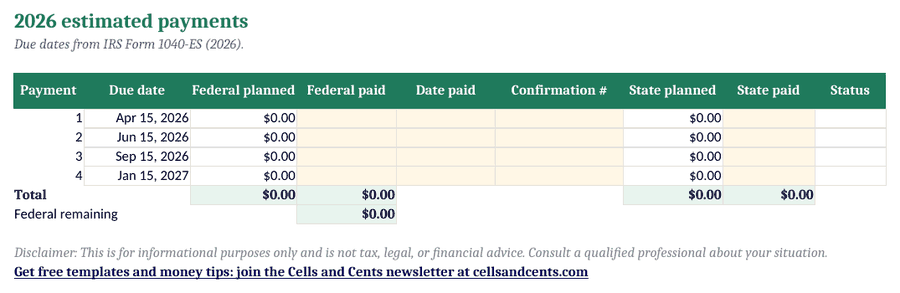
How to calculate quarterly taxes: use the Form 1040-ES worksheet to estimate your total 2026 tax, including self-employment tax. Your required annual payment is the smaller of 90% of that total or 100% of your 2025 tax (110% at higher incomes). Subtract withholding and divide by four. In our made-up example, that is $2,750.00 a quarter.
This is for informational purposes only and is not tax, legal, or financial advice.
Tax year: 2026. Every rule and figure on this page comes from Form 1040-ES (2026), Publication 505 (2026) or other IRS.gov pages, linked in each section and listed at the end. Do not use the 2026 Tax Rate Schedules for any other year.
If you only want a number, the free quarterly estimated tax calculator does the safe harbor and installment math once you know your expected 2026 tax. This guide shows where that expected tax comes from, line by line. For the safe harbor rules in more detail, see our 2026 estimated tax safe harbor guide. For turning self-employment tax into a set-aside percentage, see how much to set aside for taxes when self-employed.
The short version: four numbers
The IRS says that to figure your estimated tax, you must figure your expected adjusted gross income, taxable income, taxes, deductions, and credits for the year, and that you can use the worksheet in Form 1040-ES to do it (IRS: Estimated taxes). The worksheet boils down to four numbers:
- Total 2026 estimated tax (line 11c): income tax on your expected taxable income, plus self-employment tax and other taxes, minus credits.
- Required annual payment (line 12c): the smaller of 90% of line 11c (line 12a) or your prior year's tax (line 12b).
- What withholding does not cover (line 14a): line 12c minus income tax withheld during 2026 (line 13).
- Each installment (line 15): if your first required payment is due April 15, 2026, one quarter of line 14a, minus any 2025 overpayment you are applying to that installment.
For line 12b, Form 1040-ES says to enter 110% of your 2025 tax instead of 100% if the AGI on your 2025 return was more than $150,000 ($75,000 if married filing separately for 2026). There are also special rules for farming and fishing income.
Step 1: self-employment tax and its deduction
If you are self-employed, start with the 2026 Self-Employment Tax and Deduction Worksheet in Form 1040-ES. It gives you two numbers: self-employment tax for line 9, and the deduction for half of it, which you subtract when figuring expected AGI on line 1.
The worksheet's steps, per Form 1040-ES (2026):
- Multiply expected net profit by 92.35% (line 3).
- Multiply that by 2.9% for the Medicare part (line 4).
- Social Security applies only up to the 2026 maximum of $184,500, minus any wages subject to Social Security tax (lines 5 to 8). Multiply the smaller amount by 12.4% (line 9).
- Add the two parts for self-employment tax (line 10), and take 50% of it for the deduction (line 11).
The free self-employment tax calculator runs the same steps, and our guide on how to calculate self-employment tax explains each one.
Step 2: expected income tax (lines 1 to 8)
- Line 1: the adjusted gross income you expect in 2026. Use your 2025 return as a guide, and subtract the self-employment tax deduction from Step 1.
- Line 2a: your estimated itemized deductions or, if you do not plan to itemize, your standard deduction plus up to $1,000 ($2,000 for married filing jointly) for charitable contributions made by cash or check (see Publication 505). Form 1040-ES (2026) lists the 2026 standard deduction as $16,100 for single or married filing separately, $24,150 for head of household, and $32,200 for married filing jointly or qualifying surviving spouse, with higher amounts if you are 65 or older or blind.
- Line 2b: the estimated qualified business income deduction, if you can take it. Form 1040-ES notes that this deduction is now permanent, with a new minimum deduction of $400 for some taxpayers starting in 2026. Publication 505 has the details.
- Line 2c: any additional deduction you expect on Schedule 1-A (Form 1040), line 38.
- Line 3: line 1 minus lines 2a, 2b and 2c.
- Line 4: the tax on line 3, using the 2026 Tax Rate Schedules printed in Form 1040-ES. If you will have qualified dividends or a net capital gain, the form points you to Publication 505 instead.
- Lines 5 to 8: add alternative minimum tax and other taxes, then subtract credits (not withholding).
Step 3: total tax and the required annual payment (lines 9 to 15)
- Line 9: self-employment tax from Step 1.
- Line 10: other taxes, such as household employment taxes in some cases (see the form's instructions).
- Line 11a to 11c: add lines 8 through 10, then subtract refundable credits such as the earned income credit. Line 11c is your total 2026 estimated tax.
- Line 12a: line 11c times 90%.
- Line 12b: your 2025 tax, or 110% of it at the higher AGI levels above. If you did not file a 2025 return or it covered less than 12 months, skip 12b and use line 12a.
- Line 12c: the smaller of 12a or 12b.
- Line 13: income tax withheld and expected to be withheld during 2026.
- Line 14a: line 12c minus line 13. If it is zero or less, the form says you are not required to make estimated tax payments.
- Line 14b: line 11c minus line 13. If it is less than $1,000, the form also says you are not required to make estimated tax payments.
- Line 15: one quarter of line 14a, if your first required payment is due April 15, 2026.
Form 1040-ES adds a caution: even if you pay the required annual payment, you may still owe tax when you file, and if you prefer, you can pay the amount on line 11c. The IRS generally expects four equal payments; if your income comes in unevenly, the annualized income installment method may let you vary them (Topic 306).
Worked example: a $60,000 freelancer, line by line
These numbers are made up for illustration and are not a suggestion for what anyone should pay. Every figure was computed to the cent, and the self-employment tax and payment figures match our calculators.
Made-up facts:
- Filing status: single, no dependents, under 65
- Expected 2026 net profit from freelancing (Schedule C): $60,000, with no other income and no wages
- Standard deduction, no charitable contributions, no credits, no withholding
- 2025 tax shown on the return: $11,000, with 2025 AGI under $150,000
- To keep this example to the worksheet itself, line 2b (the qualified business income deduction) is left at zero. If you can take that deduction, it lowers line 3 and the tax on line 4.
Self-Employment Tax and Deduction Worksheet:
- Line 3: $60,000 x 92.35% = $55,410.00
- Line 4: $55,410.00 x 2.9% = $1,606.89
- Line 8: $55,410.00 (under the $184,500 maximum, with no wages)
- Line 9: $55,410.00 x 12.4% = $6,870.84
- Line 10, self-employment tax: $1,606.89 + $6,870.84 = $8,477.73
- Line 11, deduction: $8,477.73 x 50% = $4,238.87 (rounded to the cent)
2026 Estimated Tax Worksheet:
- Line 1, expected AGI: $60,000 minus $4,238.87 = $55,761.13
- Line 2a, standard deduction (single): $16,100.00. Lines 2b and 2c: none. Line 2d: $16,100.00
- Line 3: $55,761.13 minus $16,100.00 = $39,661.13
- Line 4: Schedule X (single) says the tax on an amount over $12,400 but not over $50,400 is $1,240.00 plus 12% of the amount over $12,400. That is $1,240.00 + 12% of $27,261.13 ($3,271.34) = $4,511.34
- Lines 5 to 8: no alternative minimum tax, other taxes or credits, so line 8 is $4,511.34
- Line 9, self-employment tax: $8,477.73
- Line 11c, total 2026 estimated tax: $4,511.34 + $8,477.73 = $12,989.07
- Line 12a: $12,989.07 x 90% = $11,690.16
- Line 12b: $11,000.00 (100% of the 2025 tax, since 2025 AGI was under $150,000)
- Line 12c, required annual payment: the smaller of the two, $11,000.00
- Line 13, withholding: none. Line 14a: $11,000.00. Line 14b: $12,989.07, which is not less than $1,000, so estimated payments are required
- Line 15, each installment: $11,000.00 divided by 4 = $2,750.00
The same example in the calculator
We entered these numbers in the free quarterly estimated tax calculator:
- Expected total 2026 tax (income tax plus SE tax): $12,989.07 (line 11c)
- Total tax on your 2025 return (optional): $11,000 (line 12b)
- My 2025 AGI was over $150,000 ($75,000 if married filing separately): not checked
- Expected 2026 withholding and refundable credits: none
- Estimated payments already made for 2026: none
- Plan for: Safe harbor minimum
- Plan starting from: January 1, 2026
Output: annual target $11,000.00, required from estimated payments $11,000.00, remaining to pay $11,000.00, and $2,750.00 on each of April 15, June 15 and September 15, 2026 and January 15, 2027. That matches lines 12c, 14a and 15.
With "Plan for" set to 100% of expected 2026 tax, the target becomes $12,989.07 (line 11c), and each of the four payments shows $3,247.27, rounded to the cent.
If you are figuring it now, in November
By November 18, 2026, three of the four due dates have passed. Say the first three $2,750.00 payments were made on time, for $8,250.00 in total. With the same inputs, "Estimated payments already made for 2026" set to $8,250, and "Plan starting from" set to November 18, 2026, the calculator shows:
- Safe harbor minimum: remaining to pay $2,750.00, all on January 15, 2027
- 100% of expected 2026 tax: remaining to pay $4,739.07, all on January 15, 2027
If your estimate changes during the year, the IRS says to complete another Form 1040-ES worksheet and refigure (IRS: Estimated taxes). Publication 505 (2026) uses Worksheet 2-12, the Amended Estimated Tax Worksheet, for the remaining payments, and warns that refiguring after an income increase can still leave a penalty for the earlier periods. The January payment and its exceptions are covered in our January 15, 2027 estimated tax payment guide, and if a payment was short or late, see what happens if you miss an estimated tax payment.
Logging the plan in the tracker
The Quarterly Estimated Tax Tracker does not take line 11c directly. Its Estimate tab uses the profit you enter by payment period and a flat federal income tax rate you choose, so we used a rate based on the worksheet: line 8 divided by line 1 ($4,511.34 / $55,761.13) is 8.09%, rounded. We entered these made-up numbers in a copy of the tracker and recalculated it in LibreOffice:
- Estimate tab: income of $17,000 and expenses of $2,000 in each of the four payment periods, W-2 wages none, federal rate 8.09% (the cell displays it as 8.1%), state rate 0% to keep the example federal only
- Safe Harbor tab: 2025 total tax $11,000, "2025 AGI over $150,000 ($75,000 MFS)?" set to No, expected withholding none
- Payments tab: federal paid of $2,750 on April 15, June 15 and September 15, 2026
The tracker then shows:
- Estimate tab: profit $60,000.00, self-employment tax $8,477.73, deductible half $4,238.87, income tax set-aside (at the rate you enter) $4,511.08, estimated total federal tax $12,988.81
- Safe Harbor tab: 90% of 2026 tax $11,689.93, prior-year safe harbor $11,000.00, required annual payment $11,000.00, per quarter $2,750.00
- Payments tab: $2,750.00 planned on each due date, $11,000.00 total planned, $8,250.00 paid, $2,750.00 federal remaining, and Paid status for the first three dates
The tracker's estimate is $0.26 lower than line 11c because the 8.09% rate is rounded. Both lead to the same $11,000.00 required annual payment here, because the prior-year amount is the smaller one. The tracker's flat rate is a set-aside estimate, not a substitute for the worksheet.
Keep a record
When you file, the IRS estimated tax FAQ says to report all of your estimated tax payments on Form 1040, line 26, along with any overpayment credited from your prior year return. For how to send the payment itself, see how to pay quarterly estimated taxes.
The Quarterly Estimated Tax Tracker ($17) has the 2026 due dates prefilled, a safe harbor comparison, a payment log with confirmation numbers, and federal and state columns. The quarterly estimated tax calculator is free and needs no signup.
Sources
- IRS Form 1040-ES, Estimated Tax for Individuals (2026): the 2026 Estimated Tax Worksheet and its instructions, the Self-Employment Tax and Deduction Worksheet, the 2026 standard deduction and Social Security maximum, the 2026 Tax Rate Schedules, the general rule and the 110% rule
- IRS: About Form 1040-ES: current revision and recent corrections to the form
- IRS Publication 505 (2026), Tax Withholding and Estimated Tax: worksheet line instructions and Worksheet 2-12 for refiguring
- IRS: Estimated taxes (small businesses and self-employed): how to figure estimated tax, and refiguring with another worksheet
- IRS Topic 306, Penalty for underpayment of estimated tax: four equal payments and the annualized income installment method
- IRS estimated tax FAQ: reporting payments on Form 1040, line 26
- Worked example: made-up inputs, computed to the cent from the 2026 Form 1040-ES worksheet, with the self-employment tax and payment figures matching the site's calculator functions and checked against a copy of the Quarterly Estimated Tax Tracker recalculated in LibreOffice on November 17, 2026
FAQ
How do you calculate quarterly taxes?
Form 1040-ES (2026) has a worksheet for it. You estimate your 2026 adjusted gross income, subtract deductions, figure the income tax with the 2026 Tax Rate Schedules, and add self-employment tax and other taxes to get your total 2026 estimated tax (line 11c). The required annual payment is the smaller of 90% of that total or 100% of your 2025 tax (110% if your 2025 AGI was over $150,000, or $75,000 if married filing separately). Subtract expected withholding, and if your first payment is due April 15, 2026, each installment is one quarter of the result.
Do quarterly taxes include self-employment tax?
Yes. The IRS says estimated tax is used to pay not only income tax but other taxes such as self-employment tax. On the Form 1040-ES worksheet, self-employment tax goes on line 9, figured with the Self-Employment Tax and Deduction Worksheet. Half of it is also subtracted when you figure your expected adjusted gross income on line 1.
Is the required annual payment the same as the tax I will owe?
Not always. Form 1040-ES says that even if you pay the required annual payment, you may still owe tax when you file your return, and that if you prefer, you can pay the amount on line 11c instead. In our made-up example, line 12c is $11,000.00 and line 11c is $12,989.07, so $1,989.07 could still be due at filing if the estimate holds.
Do I have to make estimated payments if I owe less than $1,000?
Form 1040-ES (2026) says that in most cases you must pay estimated tax if you expect to owe at least $1,000 for 2026 after subtracting withholding and refundable credits, and your withholding and refundable credits will be less than the smaller of 90% of your 2026 tax or 100% of your 2025 tax. On the worksheet, if line 14b (line 11c minus withholding) is less than $1,000, you stop there and are not required to make estimated tax payments.
What if my income changes partway through the year?
The IRS says to complete another Form 1040-ES worksheet to refigure your estimated tax for the next quarter. Publication 505 (2026) uses Worksheet 2-12, the Amended Estimated Tax Worksheet, to figure the payment for each remaining period. It also warns that if you refigure because income went up, you may be charged a penalty for the periods before you changed your payments.
Related template
Quarterly Estimated Tax Tracker
Track 2026 estimated payments against due dates so nothing sneaks up on you.
$17
View template