How to Pay Quarterly Estimated Taxes to the IRS
By Cells and Cents. Published November 14, 2026.
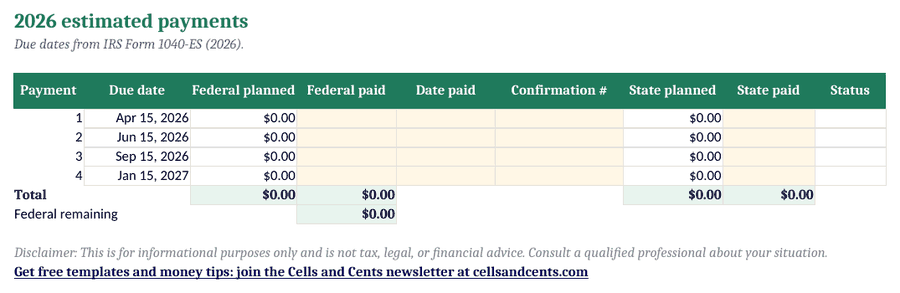
How to pay quarterly estimated taxes: pay the IRS from a bank account with Direct Pay or your IRS online account, by debit or credit card (a fee applies), or by mail with a Form 1040-ES voucher. In a made-up example, a $2,000.00 January 15, 2027 payment is sent with Direct Pay and logged in the Quarterly Estimated Tax Tracker.
This is for informational purposes only and is not tax, legal, or financial advice.
This page is about how and where to pay, and what to record afterward. It is not a walkthrough of how to calculate the installment. For due dates, including the January 15, 2027 payment, see our 2026 quarterly tax dates guide. To work out an amount, use the free quarterly estimated tax calculator or the worksheet in Form 1040-ES (2026).
Every payment rule below comes from IRS.gov or Form 1040-ES (2026). The sources are linked in each section and listed at the end.
When the payments are due
For estimated tax, the IRS splits the year into four payment periods, each with its own due date (Form 1040-ES, IRS estimated tax FAQ):
- April 15, 2026
- June 15, 2026
- September 15, 2026
- January 15, 2027
You do not have to make the January 15, 2027 payment if you file your 2026 tax return by February 1, 2027 and pay the entire balance due with it (Form 1040-ES (2026)). If a due date falls on a Saturday, Sunday, or legal holiday, a payment made on the next day that is not a Saturday, Sunday, or legal holiday is on time.
You also do not have to wait for the due date. The IRS says you can pay weekly, biweekly, or monthly, as long as enough is paid by the end of the period (IRS: Estimated taxes).
Pay from a bank account with Direct Pay
IRS Direct Pay lets you pay personal federal taxes, including estimated tax, from a checking or savings account. The IRS describes it as free and secure, with no sign-in required.
To treat the payment as estimated tax, choose estimated tax as the reason and apply it to Form 1040-ES. The IRS page on types of payments available through Direct Pay says you do not have to indicate the month or quarter associated with each payment. For a payment made in February through December, the available time period is the current calendar year. So a payment you make in late 2026 toward the January 15, 2027 installment is applied to tax year 2026.
After you submit the payment, save the confirmation number. The pay personal taxes with Direct Pay page says you will need it to look up, change or cancel the payment, and that you can also opt to get a confirmation email. You can change or cancel a payment within 2 days of the scheduled payment date.
A few limits from that same page:
- Direct Pay does not accept more than 5 payments in 24 hours.
- A payment may not equal or exceed $10 million.
- If you have never filed taxes, or it has been over 6 years since you filed, the IRS says not to use Direct Pay. Pay through your IRS online account instead, or choose another option on IRS.gov/payments.
- If you are married filing jointly, enter information for the spouse whose name is listed first on the tax return.
The same page lists Direct Pay as available Monday to Saturday, 12:00 a.m. to 11:45 p.m. ET, and Sunday, 7 a.m. to 11:45 p.m. ET.
Pay through your IRS online account
You can also pay estimated tax in your IRS online account for individuals. The IRS says you can make a same-day payment or schedule payments up to 365 days in advance from your bank account, and that you can cancel payments before their scheduled date. The same page says you can view up to 5 years of payment history, including your estimated tax payments, and view pending and scheduled payments.
If you are a new user, the IRS says to have your photo identification ready. The estimated taxes page also points to IRS.gov/account for this option.
The online account page notes that you can make a guest payment without logging in, or pay by debit or credit card.
Pay by debit card, credit card or digital wallet
You can pay most federal taxes with a debit or credit card, or with a digital wallet, through an IRS-approved processor (Pay taxes by card or digital wallet). Form 1040-ES (2026) says a fee is charged by these service providers, and that the IRS does not receive any of the fee. Current fees are listed on that IRS page and can differ by processor and card type.
The same IRS page says payment vouchers are not required if you pay by card, and that to cancel a payment you should contact the card processor. You can also pay by phone with a debit or credit card through those processors (Form 1040-ES (2026)).
The IRS estimated taxes page and the estimated tax FAQ also say you can pay by phone or from your mobile device using the IRS app.
Pay by check or money order with a Form 1040-ES voucher
If you pay by mail, Form 1040-ES (2026) includes a separate estimated tax payment voucher for each due date, with the due date shown in the upper-right corner. Complete and send in the voucher only if you are making a payment by check or money order. The form asks you to consider paying online first.
To complete the voucher and the check, Form 1040-ES (2026) says to:
- Print or type your name, address, and Social Security number (or ITIN) on the voucher. If it is a joint voucher, enter your spouse's name and SSN too, in the same order you will use on your joint return.
- Enter only the amount you are sending by check or money order in the voucher's amount box. If you are crediting a 2025 overpayment against your 2026 tax, take that credit into account when you figure what to send, but do not include the overpayment amount in that box.
- Make the check or money order payable to "United States Treasury." Do not send cash.
- Enter "2026 Form 1040-ES" and your SSN on the check or money order. For a joint voucher, enter the SSN that you will show first on your joint return.
- Enclose, but do not staple or attach, your payment with the voucher.
Mail the voucher and payment to the address in the form's "Where To File Your Estimated Tax Payment Voucher if Paying by Check or Money Order" section for the place where you live, or use the IRS where to file Form 1040-ES page. Form 1040-ES says not to mail your tax return to that address, and not to mail estimated tax payments to the address shown in the Form 1040 instructions.
If you mail your payment and it is postmarked by the due date, Form 1040-ES says the date of the U.S. postmark is considered the date of payment. The form also cautions that only the U.S. Postal Service can deliver to P.O. boxes, and that you cannot use a private delivery service to make estimated tax payments that are required to be sent to a P.O. box.
The general pay by check or money order page adds that you should allow 2 weeks for the IRS to receive and process a mailed check, and that you can view payment activity in your IRS online account.
What changed for EFTPS
Form 1040-ES (2026) still lists the Electronic Federal Tax Payment System (EFTPS) as a way to pay online or by phone from a checking or savings account if you are enrolled. The current IRS EFTPS page, though, is more recent than the form:
- Individual taxpayers can no longer create new EFTPS accounts.
- As of November 12, 2026, EFTPS is no longer available for individuals to make payments.
- If you previously scheduled a payment through EFTPS.gov, you can still sign in to cancel the payment up to two business days before the scheduled payment date.
The same page tells individuals to pay most taxes through their online account, and notes that Direct Pay now accepts additional forms. For a new individual estimated tax payment, use Direct Pay or your IRS online account, not a new EFTPS enrollment.
Worked example: paying the January 15 installment
This example starts after the amount has already been figured. It uses the same made-up figures as our January 15, 2027 estimated tax payment guide, where the free quarterly estimated tax calculator showed $2,000.00 remaining for January 15, 2027, and the Quarterly Estimated Tax Tracker planned $2,000.00 on that due date. We are not redoing that math here. These are sample numbers only, not a suggestion for what anyone should pay.
Step 1: pay $2,000.00 with Direct Pay
In this example, the payment is made on December 10, 2026, before the January 15, 2027 due date, from a checking account with IRS Direct Pay:
- Choose a personal tax payment and select estimated tax (Form 1040-ES).
- Apply the payment to tax year 2026.
- Enter $2,000.00 and the bank account details.
- Submit the payment and save the confirmation number. You can also opt to get that number by email.
Because this payment is made in December, it falls in the current-calendar-year window on the Direct Pay types page. The confirmation number in the log below is a made-up sample. Yours will come from Direct Pay or from your IRS online account.
Step 2: log it on the Payments tab
The tracker's Payments tab already has the four 2026 due dates prefilled from Form 1040-ES (2026), plus columns for Federal planned, Federal paid, Date paid, Confirmation #, State planned, State paid and Status. Federal planned is filled in from the Safe Harbor tab ($2,000.00 on each due date in this example).
The first three payments were already logged at $2,000.00 each, on April 15, June 15 and September 15, 2026. We then entered the January 15, 2027 line as follows and recalculated the workbook in LibreOffice:
- Federal paid: $2,000.00
- Date paid: December 10, 2026
- Confirmation #: a made-up sample number
Step 3: what the Payments tab shows
- January 15, 2027: Federal planned $2,000.00, Federal paid $2,000.00, Date paid December 10, 2026, Status Paid
- Total federal planned: $8,000.00
- Total federal paid: $8,000.00
- Federal remaining: $0.00
- Status is also Paid for April 15, June 15 and September 15, 2026
Status shows Paid once the amount logged is at least the planned amount, even if you paid before the due date. If you logged less than planned, it would show Partial. If a due date has passed and nothing is logged, it shows Due.
When you file your 2026 return, the IRS estimated tax FAQ says to report all of your estimated tax payments on Form 1040, line 26, and to include any overpayment you elected to credit from your prior year return.
Keep a record of what you paid
You will need your payment dates, amounts and confirmation numbers at filing time. The Quarterly Estimated Tax Tracker ($17) has the 2026 due dates prefilled, a payment log with confirmation numbers, and federal and state columns. If you would rather start with the free tools, the quarterly estimated tax calculator needs no signup.
If a payment is late or short, see what happens if you miss an estimated tax payment and the 2026 estimated tax safe harbor.
Sources
- IRS Form 1040-ES, Estimated Tax for Individuals (2026): due dates, the February 1, 2027 exception for the January payment, payment methods, voucher and check instructions, and the U.S. postmark rule
- IRS: Make a payment
- IRS Direct Pay, pay personal taxes from your bank account with Direct Pay, and types of payments available to individuals through Direct Pay
- IRS online account for individuals
- IRS: Pay taxes by card or digital wallet
- IRS: Pay by check or money order and where to file Form 1040-ES
- IRS: EFTPS: no new individual enrollments, and EFTPS no longer available for individuals to make payments as of November 12, 2026
- IRS estimated tax FAQ and IRS: Estimated taxes (small businesses and self-employed)
- IRS app
- Quarterly Estimated Tax Tracker template page: features and price
- Worked example payment log: entered in a copy of the Quarterly Estimated Tax Tracker, using the same made-up figures as the January 15, 2027 guide, and recalculated from its own formulas in LibreOffice on November 11, 2026
FAQ
How do I pay quarterly estimated taxes to the IRS?
You can pay from a bank account with IRS Direct Pay or through your IRS online account, by debit or credit card or digital wallet (a processor fee applies), or by mail with a check or money order and a Form 1040-ES payment voucher. The IRS also says you can pay by phone or from your mobile device using the IRS app. As of November 12, 2026, the IRS says EFTPS is no longer available for individuals to make payments.
Is IRS Direct Pay free?
Yes. The IRS describes Direct Pay as a free way to pay from a checking or savings account, with no sign-in required. Save the confirmation number you get when you submit the payment. You can change or cancel a payment within 2 days of the scheduled payment date.
Do I have to wait until the due date to pay?
No. The IRS says you can pay weekly, biweekly or monthly, as long as enough is paid by the end of the payment period. In our made-up example, the January 15, 2027 installment of $2,000.00 was paid on December 10, 2026, and the tracker showed it as Paid with $0.00 federal remaining.
Can I still use EFTPS to pay individual estimated taxes?
Not for a new payment. The IRS EFTPS page says individual taxpayers can no longer create new EFTPS accounts, and that as of November 12, 2026, EFTPS is no longer available for individuals to make payments. If you previously scheduled a payment through EFTPS.gov, you can still sign in to cancel it up to two business days before the scheduled payment date. Use your IRS online account or Direct Pay instead.
What should I record after I pay?
Keep the payment date, the amount and the confirmation number. You will need your estimated tax payments when you file; the IRS estimated tax FAQ says to report them on Form 1040, line 26. The Quarterly Estimated Tax Tracker has a payment log with those fields and the 2026 due dates prefilled.
Related template
Quarterly Estimated Tax Tracker
Track 2026 estimated payments against due dates so nothing sneaks up on you.
$17
View template