Home / Guides / Estimated tax safe harbor for 2026: 90%, 100% or 110%, worked through
Estimated tax safe harbor for 2026: 90%, 100% or 110%, worked through
By Cells and Cents. Published October 17, 2026.
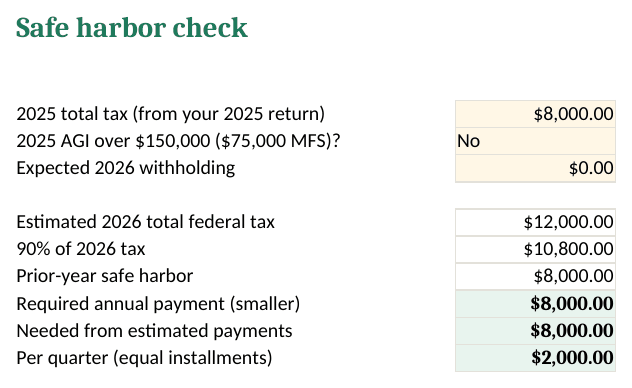
The tracker's Safe Harbor tab with a separate sample: $12,000 of estimated 2026 tax and $8,000 of 2025 tax give an $8,000 required annual payment, or $2,000 per quarter.
This is for informational purposes only and is not tax, legal, or financial advice.
The estimated tax safe harbor is the minimum the IRS generally expects you to pay during the year: the smaller of 90% of your 2026 tax or 100% of the tax on your 2025 return. If your 2025 AGI was over $150,000 ($75,000 if married filing separately), the prior-year figure is 110% instead. Withholding counts toward it.
Every rule below comes from IRS.gov. The sources are linked in each section and listed at the end.
Get the free starter budget spreadsheet
A one-month .xlsx budget with budgeted vs actual columns, automatic totals, money left over, and your savings rate. You also get our weekly email with new templates and tips; confirm by email, unsubscribe anytime.
Instant download. No spam, unsubscribe anytime.
Want the full Monthly Budget template?
Plan every dollar for the month and see what is left at a glance. Includes 12 monthly tabs plus a yearly summary, budgeted vs actual with automatic differences, customizable categories. $12.
You expect to owe at least $1,000 in tax for 2026 after subtracting withholding and refundable credits.
You expect your withholding and refundable credits to be less than the smaller of two amounts.
Those two amounts are:
90% of your 2026 tax, the tax to be shown on your 2026 return
100% of your 2025 tax, the tax shown on your 2025 return, if your 2025 AGI was $150,000 or less ($75,000 or less if your 2026 filing status is married filing separately)
110% of your 2025 tax instead of 100%, if your 2025 AGI was more than $150,000 (more than $75,000 if married filing separately)
The 2025 return must cover all 12 months. Topic 306 puts the same idea in penalty terms: most taxpayers avoid the underpayment penalty if they paid withholding and estimated tax of at least 90% of the current year's tax or 100% of the prior year's tax, whichever is smaller, with special rules for certain higher income taxpayers.
Worked example: the 110% box on and off
Here is one example run through the free quarterly estimated tax calculator, twice. The only change between the two runs is the 2025 AGI checkbox. The numbers are made up for illustration.
Inputs, as typed into the calculator:
Expected total 2026 tax (income tax plus SE tax): $40,000
Total tax on your 2025 return (optional): $30,000
Expected 2026 withholding and refundable credits: $0
Estimated payments already made for 2026: $24,000 ($8,000 each on April 15, June 15 and September 15, 2026)
Plan for: Safe harbor minimum
Plan starting from: October 17, 2026
Output with "My 2025 AGI was over $150,000 ($75,000 if married filing separately)" checked:
Annual target: $33,000.00
Required from estimated payments: $33,000.00
Remaining to pay: $9,000.00
April 15, 2026: passed
June 15, 2026: passed
September 15, 2026: passed
January 15, 2027: $9,000.00
Output with the same box not checked:
Annual target: $30,000.00
Required from estimated payments: $30,000.00
Remaining to pay: $6,000.00
April 15, 2026: passed
June 15, 2026: passed
September 15, 2026: passed
January 15, 2027: $6,000.00
How it gets there, step by step:
90% of expected 2026 tax: $40,000 x 90% = $36,000
Prior-year amount with the box checked: $30,000 x 110% = $33,000
Prior-year amount with the box not checked: $30,000 x 100% = $30,000
The safe harbor target is the smaller of step 1 and the prior-year amount: $33,000 with the box checked, $30,000 without
Remaining to pay is the target minus the $24,000 already paid: $9,000 with the box checked, $6,000 without
In this example, the 110% rule adds $3,000 to the target, and all of it lands on the January 15, 2027 line because that is the only due date left.
What changes with withholding
If you also have a W-2 job, withholding counts toward the same target. Same inputs with the box checked, but with $5,000 in "Expected 2026 withholding and refundable credits":
Annual target: $33,000.00
Required from estimated payments: $28,000.00
Remaining to pay: $4,000.00
January 15, 2027: $4,000.00
The target stays $33,000, the withholding covers $5,000 of it, and $28,000 minus the $24,000 already paid leaves $4,000.
What changes if you leave 2025 tax blank
With "Total tax on your 2025 return (optional)" left empty, the calculator has no prior-year amount to compare, so it uses 90% of 2026 tax. Same inputs otherwise:
Annual target: $36,000.00
Remaining to pay: $12,000.00
January 15, 2027: $12,000.00
Safe harbor versus paying the full expected tax
With "Plan for" set to 100% of expected 2026 tax, the annual target becomes $40,000.00 and the January 15, 2027 line becomes $16,000.00 ($40,000 minus $24,000 paid). Which approach fits depends on your situation. The safe harbor is about the penalty for underpaying during the year (Topic 306). It does not lower your 2026 tax, so in this example the difference between what you paid and your actual 2026 tax would still be due when you file.
Timing still matters
Reaching the safe harbor total by January is not always enough. The IRS says the underpayment penalty is figured separately for each installment due date, so you may owe it for an earlier due date even if you paid enough later to make up the underpayment (Instructions for Form 2210). Topic 306 adds that taxpayers should generally pay in four equal amounts, and that if your income comes in unevenly, the annualized installment method may lower or remove the penalty. The four 2026 due dates, including January 15, 2027, are listed in our 2026 quarterly tax dates guide.
No 2025 tax liability: you do not have to pay estimated tax for 2026 if you were a U.S. citizen or resident alien for all of 2025 and had no tax liability for the full 12-month 2025 tax year.
Farming and fishing: if at least two-thirds of your gross income for 2025 or 2026 is from farming or fishing, use 66 2/3% instead of 90%, and the 110% rule does not apply.
Wages: if you also receive wages, you may be able to avoid estimated payments by filing a new Form W-4 with your employer to have more withheld.
Run your own numbers
The free quarterly estimated tax calculator runs this comparison with no signup. If you want to track it all year, the Quarterly Estimated Tax Tracker has a safe harbor comparison built in (90% current year or 100%/110% prior year). Its Safe Harbor tab takes the estimated 2026 tax from the Estimate tab, which you fill in with income and expenses for each payment period, so the tax figure is not typed in directly. The tracker costs $17.
It is the smaller of 90% of your 2026 tax or 100% of the tax on your 2025 return (110% if your 2025 AGI was over $150,000, or $75,000 if married filing separately). Per IRS Topic 306, most taxpayers who pay at least that much through withholding and estimated tax avoid the underpayment penalty.
When does the 110% rule apply?
If your 2025 adjusted gross income was more than $150,000, or more than $75,000 if your 2026 filing status is married filing separately, use 110% of your 2025 tax instead of 100%.
Does the safe harbor mean I owe no more tax?
No. It is about the underpayment penalty during the year. If your 2026 tax is higher than what you paid, the rest is still due when you file.
What if I did not file a 2025 return or had no 2025 tax?
The prior-year option needs a 2025 return that covers all 12 months. Form 1040-ES also has an exception if you were a U.S. citizen or resident alien for all of 2025 and had no tax liability for the full 12-month 2025 tax year.
Can I pay the whole safe harbor amount in January?
Paying late can still mean a penalty. The IRS figures the penalty separately for each installment due date and generally expects four equal payments, unless the annualized income installment method applies.
Do farmers and fishers use the same percentages?
No. If at least two-thirds of your gross income for 2025 or 2026 is from farming or fishing, Form 1040-ES says to use 66 2/3% instead of 90%, and the 110% rule does not apply.
Related templates
Small business
Quarterly Estimated Tax Tracker
Track 2026 estimated payments against due dates so nothing sneaks up on you.