How to budget money on low income: a tight budget example
By Cells and Cents. Published November 2, 2026.
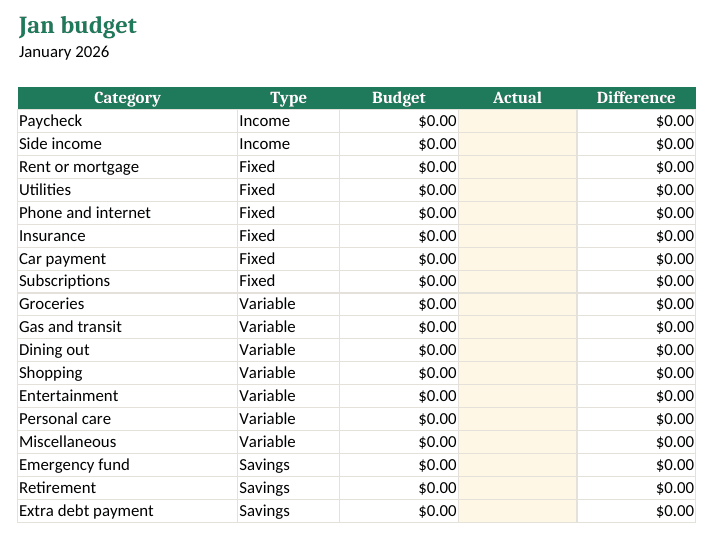
Learning how to budget money on low income starts with what you actually take home. Cover the essentials first: housing, food, utilities, transportation to work, and minimum debt payments. Give what remains to smaller needs and a little savings, then track actual spending for the month and compare it with the plan.
This is for informational purposes only and is not tax, legal, or financial advice.
Below we walk through those steps, the free CFPB worksheets that help with each one, and a worked example: a made-up tight budget entered into our Monthly Budget template, with every number taken from recalculating the actual file. Nothing here is a recommendation for your situation, and a budget does not change how much you earn.
Step 1: Start with your real take-home pay
Budget from the money that actually reaches you, not your gross pay. If your pay changes from check to check, use a recent month you have records for, or the lowest amount you usually see, so the plan does not depend on a good month.
If you receive benefits that pay for specific things, count them too. The CFPB's cash flow budget tool says to include benefits you use to pay for things that would otherwise be paid for with cash, such as SNAP and TANF, and notes that some benefits can only be used for specific expenses. SNAP, for example, can be used for food but not household items like paper towels.
Step 2: Cover the essentials first
When money is tight, the order you pay things in matters. The CFPB's Prioritizing bills tool suggests identifying what you need to pay to protect your housing and income, keep your insurance, and meet any court-ordered obligations. It groups bills like this:
- Things you need for a job: transportation to get to work (car payment, gas or bus fare), equipment or uniforms, and childcare.
- Insurance: car insurance, health insurance, and renters or home insurance.
- Things you need for housing: rent, mortgage or property taxes, gas and electric, and water, garbage and sewer.
- Obligations you have to pay: credit cards, loans, child support, and court-ordered fines and fees.
The same tool lists what can happen when each kind of bill goes unpaid: late fees, possible repossession of a car or eviction, utilities being cut off, negative entries on your credit record, and legal consequences for court-ordered obligations such as child support. It also warns that paying the "squeakiest wheel" first might not be the best approach.
Food is not on that bill list, but it is a basic need that belongs near the top of any plan. Groceries are usually the largest flexible line in a tight budget, so it helps to know what a realistic number looks like.
For a reference point, the USDA's Thrifty Food Plan, U.S. Average, September 2026 report (issued October 2026) lists a monthly cost of $253.90 for a female aged 20 to 50 and $319.00 for a male aged 20 to 50, and $1,024.00 for its reference family of a couple aged 20 to 50 with two children aged 6 to 8 and 9 to 11. Those costs are for individuals in four-person households, and the USDA suggests adding 20 percent for a one-person household. The plan assumes all meals and snacks are prepared at home, and the figures are rounded to the nearest 10 cents.
Step 3: Assign the rest, including a little savings
After the essentials, list the smaller needs (household supplies, personal care, school costs) and then anything optional. The CFPB's spending tracker suggests circling the items that are the same every month, like rent, car or cell phone payments, because these are often your needs and obligations. The areas you can eliminate or cut back on are generally wants.
Then decide on a savings amount, even a small one, before the month starts. The CFPB's guide to building an emergency fund says that if you are living paycheck to paycheck, putting any money aside can feel difficult, but even a small amount can provide some financial security. It describes an emergency fund as money set aside for unplanned expenses such as car repairs, home repairs, medical bills or a loss of income.
If a few dollars are left after everything has a job, leaving them unassigned gives the month a small buffer for bills that come in higher than planned.
Step 4: Track the month and check the timing
A plan only helps if you compare it with what really happened. The CFPB's spending tracker suggests tracking everything you earn and spend for a month, rather than a week or two, and says many people who do this discover they are spending money in small ways that add up.
Timing matters too. The cash flow budget tool is about tracking the timing of your income and expenses to make sure you have enough from week to week, because a month can balance on paper while one week still runs short. The CFPB's bill calendar suggests comparing weekly bill totals to weekly income, and if one week has more bills than income, considering asking to change the due dates of some bills.
Worked example: a low income budget example in the Monthly Budget template
We set up a made-up, one-person budget on the Setup tab of a copy of our Monthly Budget, entered made-up October 2026 spending on the Oct tab, and recalculated the workbook. The categories are editable, so we kept the ones that fit, renamed two to Credit card minimum and Household supplies, and removed the rest. These are sample numbers only, not a suggestion for what anyone should earn, spend or save.
Income (budget, then actual):
- Paycheck: $2,150.00 budgeted, $2,150.00 actual
Fixed bills:
- Rent or mortgage: $1,050.00 budgeted, $1,050.00 actual
- Utilities: $135.00 budgeted, $151.37 actual
- Phone and internet: $80.00 budgeted, $80.00 actual
- Insurance: $90.00 budgeted, $90.00 actual
- Credit card minimum: $60.00 budgeted, $60.00 actual
Variable spending:
- Groceries: $320.00 budgeted, $356.82 actual
- Gas and transit: $140.00 budgeted, $128.50 actual
- Household supplies: $35.00 budgeted, $41.19 actual
- Personal care: $30.00 budgeted, $22.48 actual
- Miscellaneous: $50.00 budgeted, $67.25 actual
Savings:
- Emergency fund: $75.00 budgeted, $75.00 actual
What the Oct tab shows at the bottom:
- Total income: $2,150.00 budgeted, $2,150.00 actual
- Total fixed: $1,415.00 budgeted, $1,431.37 actual
- Total variable: $575.00 budgeted, $616.24 actual
- Total savings: $75.00 budgeted, $75.00 actual
- Money left over: $85.00 budgeted, $27.39 actual
- Savings rate: 3.5% budgeted, 3.5% actual
How to read it, step by step:
- The plan covers essentials first. Rent, utilities, phone and internet, insurance and the credit card minimum are set up as Fixed lines and total $1,415.00. Groceries and gas and transit, the other two essentials, are the largest Variable lines.
- Difference on each line is actual minus budget. The template's Instructions tab explains that for expenses, a positive number means you overspent. Four lines show a positive difference: Groceries $36.82, Miscellaneous $17.25, Utilities $16.37 and Household supplies $6.19. Together that is $76.63 over plan.
- Green means under budget. The template turns any negative difference green. Gas and transit shows -$11.50 and Personal care shows -$7.52, $19.02 under plan in total. Overspent lines are not colored, so the place to look for overspending is any positive number in the Difference column. (The green applies to every negative difference, so an income line that came in below plan would turn green too.)
- Totals add every line of the same type. Fixed bills came to $1,431.37 against $1,415.00 planned, and variable spending came to $616.24 against $575.00 planned.
- Money left over is total income minus total fixed, total variable and total savings. The plan left $85.00 unassigned as a buffer. The actual month left $27.39: $2,150.00 minus $1,431.37, minus $616.24, minus $75.00. The $57.61 drop is the $76.63 of overspending minus the $19.02 that came in under. If spending had gone past the buffer, money left over would have shown a negative amount.
- Savings rate is total savings divided by total income: $75.00 of $2,150.00 is 3.5% in both the plan and the actual month. Because the emergency fund line was paid as planned, the overspending came out of the buffer instead of out of savings.
The Summary tab picks up the same October actuals: income $2,150.00, fixed $1,431.37, variable $616.24, savings $75.00, left over $27.39 and a 3.5% savings rate.
What the example shows is the pattern. In a tight budget, a small unassigned buffer is what absorbs a higher utility bill or a bigger grocery trip. The Difference column then points to where next month's plan needs a change, either a higher budget for that line or a cut somewhere else.
How to budget and save money for beginners
If this is your first budget, a short routine keeps it manageable:
- Write down your take-home pay for the month.
- List the bills that are the same every month, starting with housing, utilities, insurance, transportation to work and minimum debt payments.
- Set amounts for food and other variable needs, based on what you actually spent last month if you have the receipts or statements.
- Add one savings line, even a small one, and leave any remainder as a buffer.
- Record what you actually spend during the month, then compare it with the plan and adjust next month.
If you are looking for how to budget money for beginners as a PDF, the CFPB's free Your Money, Your Goals toolkit has printable worksheets for each of these steps, including the spending tracker, bill calendar, prioritizing bills tool, cash flow budget and a savings plan. The savings plan divides the amount you want to save by the number of weeks you have to save it, and suggests brainstorming ways to decrease spending or increase income to meet that weekly target.
For more detail, our personal budget example walks through a full month with more categories, what a sinking fund is shows how to save a little at a time for a known bill, and how to set a savings goal covers turning a target and date into a monthly amount. Once the budget has some room, how an extra principal payment works shows what adding $100 a month does to a loan.
Templates for a tight budget
The Monthly Budget template costs $12. It has 12 monthly tabs plus a yearly summary, budgeted vs actual with automatic differences, customizable categories, savings rate and money left over on every month, and a chart on the Summary tab. If you want to start with a simpler one-month version, the free starter budget spreadsheet has budgeted vs actual columns, automatic totals, money left over and a savings rate.
When the emergency fund line starts to grow, the Savings Goals Tracker costs $12. It tracks up to 10 goals with the monthly amount needed for each target date, a deposit log, progress bars and an emergency fund calculator based on months of expenses.
These are .xlsx files built for Excel. They only total the numbers you enter; they do not connect to any bank accounts or move any money.
Sources
- CFPB, Prioritizing bills (Your Money, Your Goals toolkit): protecting housing and income, insurance and court-ordered obligations, the bill groups, the consequences of missed bills, and the "squeakiest wheel" warning
- CFPB, Spending tracker: tracking for a month, small amounts that add up, and needs and obligations vs wants
- CFPB, Creating a cash flow budget: week to week timing and counting benefits such as SNAP and TANF
- CFPB, Bill calendar: comparing weekly bills to weekly income and asking to change due dates
- CFPB, Savings plan: dividing a savings goal by the weeks you have to save
- CFPB, An essential guide to building an emergency fund: what an emergency fund is for and that even a small amount can provide some financial security
- CFPB, Your Money, Your Goals toolkit: the full list of free PDF tools
- USDA, Official USDA Thrifty Food Plan: U.S. Average, September 2026 (issued October 2026): monthly costs of $253.90, $319.00 and $1,024.00 and the household size adjustment
- Monthly Budget template page, Savings Goals Tracker template page and free starter budget spreadsheet: features and prices
- All example results: recalculated from the Monthly Budget template's own formulas in LibreOffice
FAQ
What should I pay first on a low income budget?
The CFPB's Prioritizing bills tool suggests identifying what you need to pay to protect your housing and income, keep your insurance, and meet any court-ordered obligations. Its list covers transportation to work, insurance, rent and utilities, and obligations such as credit cards, loans and child support. Food is a basic need to plan for alongside those.
What does a low income budget example look like?
In our made-up example, take-home pay is $2,150 a month. The plan puts $1,415 toward fixed bills, $575 toward variable spending such as groceries and gas, and $75 toward an emergency fund, which leaves $85 unassigned as a buffer. In the actual month, spending ran over in four categories and money left over fell to $27.39.
Does the Monthly Budget template highlight overspending?
Not with a color. The Difference column shows actual minus budget, so for an expense a positive number means you spent more than planned. Negative differences, meaning a line came in under budget, turn green. Money left over at the bottom of each month tab shows how much income is left after fixed bills, variable spending and savings.
Is there a free budgeting PDF for beginners?
The Consumer Financial Protection Bureau publishes free PDF worksheets in its Your Money, Your Goals toolkit, including a spending tracker, a cash flow budget, a bill calendar, a prioritizing bills tool and a savings plan. They are fillable PDFs, so you can type into them on screen or print them and fill them in by hand.
Can you save money on a low income?
The CFPB's emergency fund guide says that if you are living paycheck to paycheck, putting any money aside can feel difficult, but even a small amount can provide some financial security. A small savings line in the budget, like the $75 in our example, makes saving part of the plan instead of whatever happens to be left.
Related templates
Monthly Budget
Plan every dollar for the month and see what is left at a glance.
$12
View templateSavings Goals Tracker
Set goals, track deposits, and see the monthly amount needed to hit each one.
$12
View template