Extra principal payment calculator: one loan, two plans
By Cells and Cents. Published November 1, 2026.
An extra principal payment calculator compares paying only your minimum on a loan with paying a bit more each month. In our example, adding $100 a month to a made-up $18,000 car loan at 7.49% APR cut the payoff from 53 months to 41 and total interest from $3,196.16 to $2,451.30.
This is for informational purposes only and is not tax, legal, or financial advice.
Below we explain what an extra principal payment is, what to check on your loan first, and then walk through one loan entered in our spreadsheet twice. Every number in the example comes from recalculating the actual planner file. Nothing here is a recommendation for your situation.
What an extra principal payment is
The Consumer Financial Protection Bureau (CFPB) explains, in How does paying down a mortgage work?, that the amount you borrow is called the principal, that part of each monthly payment goes toward paying off the principal and part pays interest, and that interest is what the lender charges you for lending you money. Its answer on auto loans uses the same split between principal and interest.
An extra principal payment is any amount you pay above the required monthly payment that goes toward the balance. The CFPB's mortgage key terms explain why that matters: when a payment on the principal is made, the borrower owes less, and will pay less interest based upon a lower loan size.
The CFPB's answer on amortization and auto loans adds that at the beginning of a loan term, more of your payment is generally applied toward the interest rather than the principal, and that the principal balance decreases slowly at first. An extra payment early on goes straight at that slow-moving balance.
Check your loan before you pay extra
Two things in your loan contract affect whether extra payments do what a calculator shows.
- Prepayment penalties. The CFPB's answer Can I prepay my loan at any time without penalty? says your contract and state law will determine whether you can pay off your auto loan early, that your lender may include a penalty or fee if you pay it off early, and that some states prohibit prepayment penalties for certain loans. For mortgages, the CFPB defines a prepayment penalty as a fee that some lenders charge if you pay off all or part of your mortgage early.
- How interest is calculated. The CFPB's answer on simple vs precomputed interest says simple interest, which is far more common, is calculated on the outstanding balance on a daily or monthly basis. With precomputed interest, it says making extra payments does not reduce the principal amount (or interest) owed.
If your loan uses simple interest and has no prepayment penalty, a comparison like the one below is a reasonable way to see the effect of paying more. If you are not sure, your contract and your lender are the places to check.
Worked example: one car loan, minimum vs $100 extra
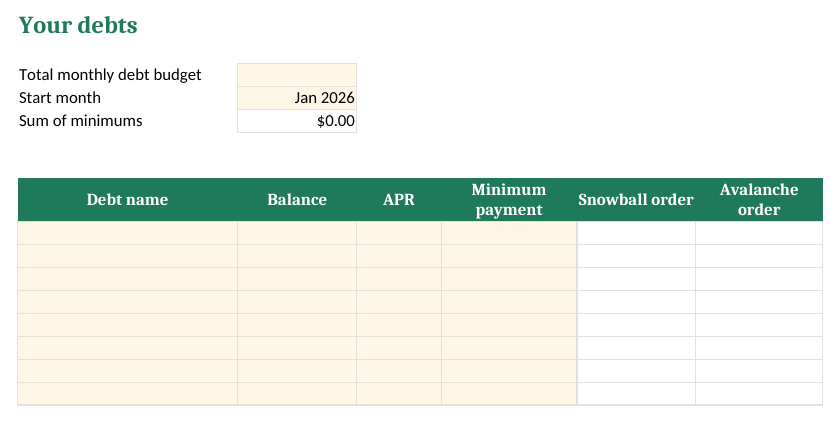
We entered one made-up car loan into a copy of our Debt Payoff Planner twice and recalculated it each time. The only input that changed was the total monthly debt budget.
Inputs on the Debts tab (both runs):
- Debt name: Car loan
- Balance: $18,000
- APR: 7.49%
- Minimum payment: $400
- Start month: December 2026
Run 1, minimum only: total monthly debt budget $400
Run 2, minimum plus extra: total monthly debt budget $500, so $100 a month goes to extra payments
What the Debts tab shows:
- Sum of minimums: $400 in both runs, with no budget warning, since neither budget is below the minimum
What the Summary tab shows:
- Months to debt-free: 53 (minimum only), 41 (with $100 extra)
- Debt-free month: April 2031 (minimum only), April 2030 (with $100 extra)
- Total interest: $3,196.16 (minimum only), $2,451.30 (with $100 extra)
With a single debt, the Snowball and Avalanche columns show the same numbers, because there is only one debt to send extra money to.
How to read it, step by step:
- Month 1 interest is the same in both runs: $18,000 x 7.49% / 12 = $112.35. The planner estimates interest monthly as APR divided by 12 on the balance.
- Run 1 pays $400, so the balance after month 1 is $18,000 + $112.35 - $400 = $17,712.35.
- Run 2 pays $400 plus $100 extra, so the balance after month 1 is $18,000 + $112.35 - $500 = $17,612.35.
- In month 2, interest is $110.55 in run 1 and $109.93 in run 2, because run 2 starts the month with a balance $100 lower.
- The gap keeps growing. After 12 months the balance is $14,427.19 in run 1 and $13,185.14 in run 2. After 24 months it is $10,577.42 and $7,997.02.
- Run 2 ends in month 41 with a final payment of $451.30 ($400 minimum plus $51.30 extra). Run 1 ends in month 53 with a final payment of $396.16.
- The difference: 12 fewer months and $744.86 less in total interest ($3,196.16 minus $2,451.30). Total paid is $21,196.16 in run 1 and $20,451.30 in run 2.
These results apply to this made-up loan only. A different balance, rate, minimum or extra amount gives different results, and your lender's actual interest calculation may differ from the planner's estimate.
Using it as a car loan or personal loan calculator
The same steps work as a remaining car loan payoff calculator or a personal loan extra payment calculator. Enter what you owe today as the balance, your APR, and your required monthly payment as the minimum. Run it once with your total monthly debt budget equal to that payment, then again with the budget raised by the extra amount you are considering, and compare months to debt-free, the debt-free month and total interest.
If you have more than one debt, the planner works as a debt repayment calculator for up to 10 debts, and it decides which debt gets the extra money by snowball or avalanche order. Our guide to debt snowball vs avalanche walks through that with four debts, and the debt payoff spreadsheet template guide covers each tab.
Try it with your own loan
The Debt Payoff Planner costs $17. It takes up to 10 debts, each with a balance, APR and minimum payment, plus your total monthly debt budget, and builds a month-by-month schedule with the debt-free date, total interest and a progress chart. If you want to find room for an extra payment first, the Monthly Budget tracks budgeted vs actual spending by category.
Sources
- CFPB, Mortgage key terms: that a payment on the principal means the borrower owes less and pays less interest
- CFPB, How does paying down a mortgage work?: principal as the amount you borrow, and interest as what the lender charges you for lending you money
- CFPB, What is amortization and how could it affect my auto loan?: how early payments are split between interest and principal
- CFPB, Can I prepay my loan at any time without penalty?: auto loan prepayment penalties
- CFPB, What is a prepayment penalty?: the mortgage definition
- CFPB, Simple interest vs precomputed interest on an auto loan: how each interest method treats extra payments
- Debt Payoff Planner template page: features, the up to 10 debts limit, and price
- All example results: recalculated from the planner's own formulas on October 30, 2026
FAQ
What does an extra principal payment calculator show?
It compares paying only the minimum on a loan with paying the minimum plus an extra amount each month. The main outputs are how many months the loan takes to pay off, the payoff month, and the total interest paid under each plan.
How much did $100 extra a month change the example loan?
For the made-up $18,000 car loan at 7.49% APR with a $400 minimum, the Debt Payoff Planner showed 53 months and $3,196.16 of interest at the minimum, and 41 months and $2,451.30 of interest with $100 extra. That is 12 fewer months and $744.86 less interest in this example only.
Can a lender charge a fee for paying a loan off early?
Some can. The CFPB says your contract and state law determine whether you can pay off an auto loan early, that a lender may include a penalty or fee for paying it off early, and that some states prohibit prepayment penalties for certain loans.
Do extra payments always lower the interest on a car loan?
Not always. The CFPB explains that with precomputed interest, making extra payments does not reduce the principal amount (or interest) owed, while simple interest, which it says is far more common, is calculated on the outstanding balance.
Can I use the Debt Payoff Planner for a single loan?
Yes. Enter one debt with its balance, APR and minimum payment, then set the total monthly debt budget. Anything above the minimum goes to extra payments. With one debt, the snowball and avalanche columns show the same result.
Related templates
Debt Payoff Planner
Compare snowball and avalanche plans and see your debt-free date.
$17
View templateMonthly Budget
Plan every dollar for the month and see what is left at a glance.
$12
View template