Credit card debt calculator: minimum vs fixed payment
By Cells and Cents. Published November 3, 2026.
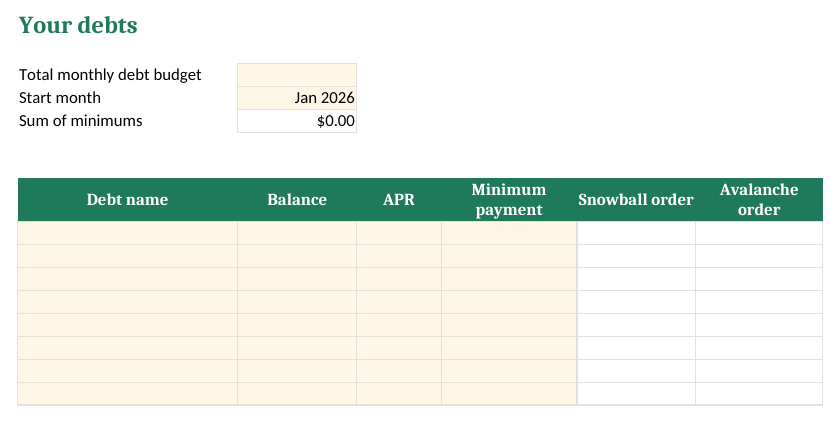
A credit card debt calculator shows how long a balance takes to pay off and how much interest it costs at a given monthly payment. In our example, a made-up $4,000 card at 22.99% APR took 77 months and $3,661.35 of interest at $100 a month, and 26 months and $1,092.48 at $200.
This is for informational purposes only and is not tax, legal, or financial advice.
Below we explain the minimum payment warning printed on credit card statements, how card interest and minimum payments work, and then walk through one card entered in our spreadsheet at two monthly payments. Every number in the example comes from recalculating the actual planner file. Nothing here is a recommendation for your situation.
The minimum payment warning on your statement
Your monthly statement already includes a small credit card debt calculator. Section 201 of the Credit Card Accountability Responsibility and Disclosure Act of 2009 (the Credit CARD Act), approved May 22, 2009, added payoff timing disclosures to the Truth in Lending Act. The current wording is set by the regulation that implements it, 12 CFR 1026.7(b)(12) in Regulation Z.
For most credit card accounts, that regulation says each periodic statement must include:
- A bold heading and this statement: "Minimum Payment Warning: If you make only the minimum payment each period, you will pay more in interest and it will take you longer to pay off your balance."
- The minimum payment repayment estimate, which is how long payoff takes if you pay only the minimum. It is shown in months if under 2 years, and otherwise in years rounded to the nearest whole year.
- The minimum payment total cost estimate, which is what you would pay in total under that minimum-only plan.
- A statement that both estimates are based on the current balance shown on the statement and assume that only minimum payments are made and no other amounts are added to the balance.
- A toll-free number for information about credit counseling services.
- In most cases, the estimated monthly payment to repay the balance in 36 months, the total cost of repaying it that way, and the savings compared with paying only the minimum. The regulation drops these 36-month lines in some cases, for example when the minimum payment estimate rounds to 3 years or less.
The box is a quick snapshot of one balance on one statement date. A spreadsheet lets you try any payment amount you choose and see the month-by-month schedule behind it.
How card interest and minimum payments work
The Consumer Financial Protection Bureau (CFPB) credit card key terms page says credit card interest rates are typically stated as a yearly rate called the annual percentage rate (APR), and that on most cards you can avoid paying interest on purchases if you pay your balance in full each month by the due date.
How the interest is figured varies by card. The CFPB's answer How does my credit card company calculate the amount of interest I owe? says many card companies calculate interest daily, based on your average daily balance. It also says that when you pay more than the minimum but less than the full balance, the issuer must generally apply the amount over the minimum first to the balance with the highest interest rate.
Minimum payments are set by a formula in your card agreement. Appendix M1 of Regulation Z, which describes how the repayment disclosures are calculated, says issuers must use the minimum payment formula that applies to your account. One of its own examples is a minimum of 2 percent of the outstanding balance or $20, whichever is greater. With a formula like that, the minimum goes down as the balance goes down.
What the planner can and cannot model
Our Debt Payoff Planner takes each debt's balance, APR and minimum payment as a fixed dollar amount, plus one total monthly debt budget. Anything in the budget above the minimums goes to extra payments. It estimates interest monthly as APR divided by 12 on the balance, rounded to the cent.
That means it cannot model a percent-of-balance minimum that shrinks each month. What it can model is a fixed monthly payment, which is what the example below compares: $100 a month held steady, against $200 a month held steady. If your card's minimum falls as the balance falls, paying only that minimum would pay the card down more slowly than holding the payment at its starting amount, so treat the $100 run as a fixed payment, not as your statement's minimum-only estimate. Your card's daily interest calculation can also differ from the planner's monthly estimate.
Worked example: one card, $100 vs $200 a month
We entered one made-up credit card into a copy of the Debt Payoff Planner and recalculated it with LibreOffice. The only input that changed between runs was the total monthly debt budget.
Inputs on the Debts tab (all runs):
- Debt name: Credit card
- Balance: $4,000
- APR: 22.99%
- Minimum payment: $100
- Start month: December 2026
- No new purchases (the planner only tracks the balance you enter)
Run 1, fixed $100: total monthly debt budget $100
Run 2, fixed $200: total monthly debt budget $200, so $100 a month goes to extra payments
What the Debts tab shows:
- Sum of minimums: $100 in both runs, with no budget warning, since neither budget is below the minimum
What the Summary tab shows:
- Months to debt-free: 77 (at $100), 26 (at $200)
- Debt-free month: April 2033 (at $100), January 2029 (at $200)
- Total interest: $3,661.35 (at $100), $1,092.48 (at $200)
With a single debt, the Snowball and Avalanche columns show the same numbers, because there is only one debt to send extra money to.
How to read it, step by step:
- Month 1 interest is the same in both runs: $4,000 x 22.99% / 12 = $76.63.
- Run 1 pays $100, so the balance after month 1 is $4,000 + $76.63 - $100 = $3,976.63. Only $23.37 of that payment reduced the balance.
- Run 2 pays $200, so the balance after month 1 is $4,000 + $76.63 - $200 = $3,876.63.
- In month 2, interest is $76.19 in run 1 and $74.27 in run 2, because run 2 starts the month with a balance $100 lower.
- The gap keeps growing. After 12 months the balance is $3,688.08 in run 1 and $2,353.21 in run 2. After 24 months it is $3,296.41 and $285.27.
- Run 2 ends in month 26 with a final payment of $92.48. Run 1 ends in month 77 with a final payment of $61.35.
- The difference: 51 fewer months and $2,568.87 less in total interest ($3,661.35 minus $1,092.48). Total paid is $7,661.35 in run 1 and $5,092.48 in run 2.
A third run, for a 36-month payoff: to mirror the 36-month line on a statement, we tried whole-dollar budgets until the planner showed 36 months. A budget of $154 showed 37 months. A budget of $155 showed 36 months, a debt-free month of November 2029, and $1,570.65 of total interest, with a final payment of $145.65. This is the planner's figure, not your issuer's, since the regulation sets its own calculation method for the statement estimate.
These results apply to this made-up card only. A different balance, rate or payment gives different results, and new purchases on the card would add to the balance and lengthen the payoff.
Using it as a monthly payment credit card calculator
The same steps work for your own card. Enter the balance from your latest statement, your purchase APR, and a monthly payment as the minimum. Set the total monthly debt budget to the amount you plan to pay, then raise or lower the budget and compare months to debt-free, the debt-free month and total interest. To find the credit card monthly payment that clears the balance by a target month, adjust the budget until the debt-free month lands where you want it.
If you have more than one card, the planner works for up to 10 debts and decides which one gets the extra money by snowball or avalanche order. Our guide to debt snowball vs avalanche walks through that with four debts, the extra principal payment guide runs the same comparison on a car loan, and the debt payoff spreadsheet template guide covers each tab.
Try it with your own card
If you are looking for a free debt calculator, the minimum payment warning box on each statement gives you a set of payoff estimates at no cost. The Debt Payoff Planner costs $17. It takes up to 10 debts, each with a balance, APR and minimum payment, plus your total monthly debt budget, and builds a month-by-month schedule with the debt-free date, total interest and a progress chart. If you want to find room for a larger payment first, the Monthly Budget tracks budgeted vs actual spending by category.
Sources
- Credit Card Accountability Responsibility and Disclosure Act of 2009, Public Law 111-24, on GovInfo: the Act's name, its May 22, 2009 approval date, and Section 201 payoff timing disclosures
- CFPB, 12 CFR 1026.7 Periodic statement, paragraph (b)(12): the current Minimum Payment Warning wording and the required repayment disclosures
- CFPB, Appendix M1 to Part 1026, Repayment Disclosures: issuers use the account's minimum payment formula, and the 2 percent or $20 example
- CFPB, Credit cards key terms: APR as a yearly rate, and avoiding interest on purchases by paying in full
- CFPB, How does my credit card company calculate the amount of interest I owe?: daily interest on the average daily balance, and how amounts over the minimum are applied
- CFPB, Credit cards: more consumer resources on credit cards
- Debt Payoff Planner template page: features, the up to 10 debts limit, and price
- All example results: recalculated from the planner's own formulas on November 1, 2026
FAQ
What does a credit card debt calculator show?
It takes a card balance, its APR and a monthly payment, and shows how many months the balance takes to pay off and how much interest you pay along the way. Running it twice with two payment amounts shows what the larger payment changes.
How much did paying $200 a month instead of $100 change the example?
For the made-up $4,000 card at 22.99% APR, the Debt Payoff Planner showed 77 months and $3,661.35 of interest at $100 a month, and 26 months and $1,092.48 of interest at $200 a month. That is 51 fewer months and $2,568.87 less interest in this example only.
What is the minimum payment warning on a credit card statement?
It is a box that Regulation Z requires on credit card statements. It starts with a bold Minimum Payment Warning heading, then shows how long it would take to pay off the statement balance and the total cost if you make only minimum payments, usually a monthly payment that would pay it off in 36 months, and a toll-free number for credit counseling information.
Why might my card's minimum-only payoff take longer than a fixed payment calculator shows?
Card minimums are set by a formula in the card agreement, and a formula tied to the balance, like the 2 percent or $20 example in Regulation Z, gets smaller as the balance falls. A calculator that holds the payment at one fixed dollar amount, like the Debt Payoff Planner, keeps paying the starting amount, which pays the balance down faster than a shrinking minimum would.
Can I use the Debt Payoff Planner for more than one credit card?
Yes. It takes up to 10 debts, each with a balance, APR and minimum payment, plus one total monthly debt budget, and compares the snowball and avalanche orders for sending extra money to each debt.
Related templates
Debt Payoff Planner
Compare snowball and avalanche plans and see your debt-free date.
$17
View templateMonthly Budget
Plan every dollar for the month and see what is left at a glance.
$12
View template