How Is Credit Card Interest Calculated? A Worked Example
By Cells and Cents. Published November 12, 2026.
How is credit card interest calculated? Many issuers calculate interest daily: they divide your APR by 360 or 365, depending on the issuer, to get a daily periodic rate, then apply it to your average daily balance for each day of the billing cycle. In our made-up example, a $1,569.28 average daily balance at 22.99% APR over a 30-day cycle cost $29.65.
This is for informational purposes only and is not tax, legal, or financial advice.
Below we go step by step: APR to daily periodic rate, the balance for each day, the average daily balance, and the interest for the cycle. Then we work one made-up billing cycle out to the cent, show what changes with daily compounding, a 360-day year, or an earlier payment, and point to where each number appears on a statement. If you want to see how a card's interest adds up over a full payoff, our credit card debt calculator guide covers that.
Step 1: turn the APR into a daily periodic rate
The Consumer Financial Protection Bureau (CFPB) says a credit card's interest rate is the price you pay for borrowing money, and that card interest rates are typically stated as a yearly rate called the annual percentage rate (APR).
Card interest is usually not charged once a year, though. The CFPB says many card companies calculate the interest you owe daily, and the interest rate charged daily is called the daily periodic rate. Its page on the daily periodic rate says it generally can be calculated by dividing the APR by either 360 or 365, depending on the card issuer.
So the first step is:
- Daily periodic rate = APR / 365 (or APR / 360, if that is what your card agreement uses)
Many cards also have more than one APR. The CFPB notes that card companies often charge one rate for purchases and different rates for cash advances, checks written on the card account, or other transactions, and your statement must show each category with a different APR and the balance in each.
For context on typical rates: in the Federal Reserve's G.19 Consumer Credit release dated November 6, 2026, the average interest rate on commercial bank credit card plans was 22.36 percent for accounts assessed interest and 21.19 percent for all accounts in the third quarter of 2026 (both marked preliminary).
Step 2: find the balance for each day
The daily rate is applied to a balance, and which balance depends on the card. Regulation Z (12 CFR Part 1026) names the balance computation methods an issuer may describe by name in 12 CFR 1026.60(g):
- Average daily balance (including new purchases): add the outstanding balance for each day in the billing cycle, including new purchases and deducting payments and credits, then divide by the number of days in the cycle.
- Average daily balance (excluding new purchases): the same, but without new purchases.
- Adjusted balance: the balance at the beginning of the cycle minus payments and credits made during the cycle.
- Previous balance: the balance at the beginning of the cycle.
- Daily balance: for each day, the beginning balance plus new purchases minus payments and credits.
The CFPB says many issuers use the average daily balance, so that is the method in our example. Your card agreement says which one your card uses: under 12 CFR 1026.6, the account-opening disclosures must explain the method used to determine the balance to which the rate is applied.
To build the daily balances, start with the balance on the first day of the cycle and change it on each day something posts: add purchases, subtract payments and credits.
Step 3: average the daily balances
Add up the balance for every day in the cycle, then divide by the number of days in the cycle. A 30-day cycle has 30 daily balances; a 31-day cycle has 31. Days when nothing happens still count, at whatever the balance was that day.
A shortcut that gives the same total: group the days by balance. If the balance was $1,500.00 for 7 days, that group adds $10,500.00 to the total.
Step 4: calculate the interest for the cycle
Multiply the average daily balance by the daily periodic rate, then by the number of days in the cycle:
- Interest = average daily balance x daily periodic rate x days in the cycle
Because the average is the total divided by the days, this is the same as multiplying the sum of the daily balances by the daily rate.
Some cards go one step further. The CFPB's daily periodic rate page says a daily rate generally is used by multiplying it by the amount owed at the end of each day, and that interest amount is then added to the previous day's balance, which means interest compounds daily. With daily compounding, each day's interest also earns interest for the rest of the cycle, so the total comes out slightly higher. The example below shows both.
When the calculation does not apply: the grace period
If you pay in full, there may be nothing to calculate. The CFPB's page on the grace period defines it as the period between the end of a billing cycle and the date your payment is due. If your card gives a grace period and you are not carrying a balance, you can avoid paying interest on new purchases by paying your balance in full by the due date.
The same page says:
- Card companies are not required to give a grace period, but most cards provide one on purchases.
- If you lose the grace period by not paying in full, you are charged interest on the unpaid portion of the balance, and on purchases in the new billing cycle starting on the date each purchase is made.
- Grace periods typically apply only to purchases. For a cash advance, or a check from your card issuer, you generally start paying interest as of the date of the transaction.
- If you pay in full some months and not others, you may lose the grace period for the month you do not pay in full and the month after.
Regulation Z also limits how issuers can charge interest after a lost grace period. 12 CFR 1026.54 says a card issuer must not impose finance charges as a result of the loss of a grace period if they are based on balances for days in billing cycles before the most recent cycle, or on any portion of a balance subject to a grace period that was repaid before the grace period expired.
Worked example: one billing cycle at 22.99% APR
This is a made-up card and a made-up billing cycle, calculated with exact math (no estimates) using the average daily balance method (including new purchases) and APR / 365. Real cards differ in their method, day count, and when transactions start accruing, so your statement can differ.
The cycle
- Billing cycle: September 1 to September 30, 2026 (30 days)
- Purchase APR: 22.99%
- Balance on September 1: $1,500.00, carried over from the previous statement and not paid in full, so this card has no grace period this cycle and new purchases accrue interest from the day they are made
- September 8: purchase of $240.00
- September 18: payment of $300.00
- September 24: purchase of $65.50
- No cash advances, fees, or other credits
Step 1: the daily periodic rate
22.99% / 365 = 0.2299 / 365 = 0.000629863 per day (rounded to nine decimal places here; the math below uses the unrounded rate). As a percentage, that is about 0.0630% a day.
Step 2: the daily balances
- September 1 to 7: 7 days at $1,500.00 = $10,500.00
- September 8 to 17: 10 days at $1,740.00 ($1,500.00 + $240.00) = $17,400.00
- September 18 to 23: 6 days at $1,440.00 ($1,740.00 - $300.00) = $8,640.00
- September 24 to 30: 7 days at $1,505.50 ($1,440.00 + $65.50) = $10,538.50
That covers all 30 days (7 + 10 + 6 + 7). The sum of the daily balances is $47,078.50.
Step 3: the average daily balance
$47,078.50 / 30 days = $1,569.28 (rounded to the cent from $1,569.2833).
Step 4: the interest for the cycle
$1,569.2833 x 0.000629863 x 30 days, which is the same as $47,078.50 x 0.2299 / 365, = $29.653006, or $29.65 of interest for the cycle.
Before interest, the balance at the end of the cycle is $1,505.50. Adding the $29.65 interest charge gives a new balance of $1,535.15.
The same cycle with daily compounding
If each day's interest is added to the balance for the next day, as the CFPB describes for daily compounding, the cycle's interest is $29.93 instead of $29.65, or $0.28 more.
The same cycle with a 360-day year
Using APR / 360, the daily rate is 0.2299 / 360 = 0.000638611 (rounded). Interest becomes $47,078.50 x 0.2299 / 360 = $30.06, or $0.41 more than with 365. With daily compounding on top, it is $30.35.
The same cycle with the payment 10 days earlier
Suppose the $300.00 payment posts on September 8 instead of September 18. The balance is $300.00 lower for 10 more days, which takes $3,000.00 off the sum of the daily balances: $47,078.50 - $3,000.00 = $44,078.50. The average daily balance drops to $1,469.28, and the interest becomes $44,078.50 x 0.2299 / 365 = $27.76, which is $1.89 less.
That matches what the CFPB says about daily interest: because interest accrues daily, if you do not have a grace period, the sooner you pay off all or some of your balance, the less interest you pay.
These figures apply to this made-up cycle only.
Where these numbers appear on your statement
Regulation Z's periodic statement rule, 12 CFR 1026.7, requires the pieces you need to check the math. Paragraph (b)(5) requires the amount of the balance to which a periodic rate was applied, labeled Balance Subject to Interest Rate, with an explanation of how that balance was determined. An issuer that uses a method named in 1026.60(g) may instead name the method and give a toll-free number for more information.
Paragraph (b)(6) requires interest charges to be grouped under the heading Interest Charged, itemized and totaled by type of transaction, with Total Interest shown for the statement period and the calendar year to date. Each APR that could apply is listed under paragraph (b)(4).
To check a statement that uses an average daily balance, take the Balance Subject to Interest Rate for one balance type, multiply by the APR, divide by 365 or 360 (whichever your agreement uses), and multiply by the days in the billing cycle. If your card compounds daily or uses a different method, expect a small difference.
How this compares with a monthly estimate
A spreadsheet that plans a payoff over many months usually simplifies the daily math. Our Debt Payoff Planner estimates interest monthly as APR / 12 on the balance, rounded to the cent, and its instructions note that your lender's actual calculation may differ.
We entered a $1,500.00 balance at 22.99% APR into a copy of the planner and recalculated it with LibreOffice. Month 1 interest showed as $28.74 ($1,500.00 x 22.99% / 12 = $28.74). The daily calculation for our cycle came to $29.65, because the purchases raised the average daily balance above $1,500.00. The monthly figure is a planning estimate; the daily calculation is closer to how many issuers figure a single statement.
For what the interest adds up to over a whole payoff, and what a larger payment changes, see our credit card debt calculator guide. For more than one card, the debt snowball vs avalanche guide compares payoff orders.
Planning a payoff
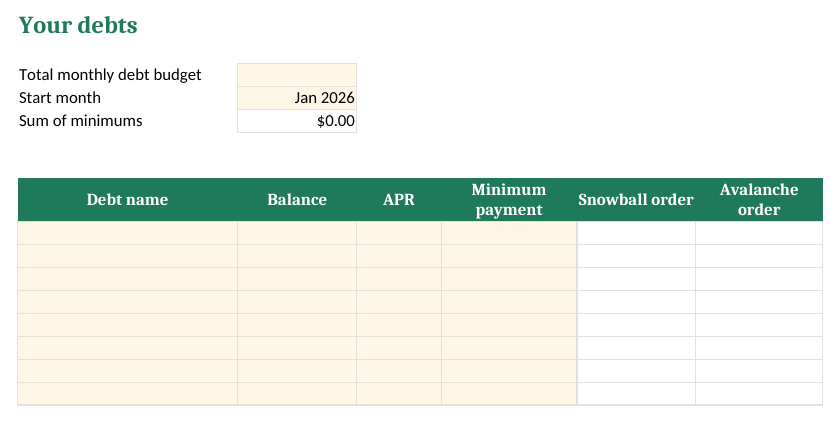
The Debt Payoff Planner costs $17. It takes up to 10 debts, each with a balance, APR and minimum payment, plus a total monthly debt budget, and shows a month-by-month schedule, the debt-free date and total interest for the snowball and avalanche methods side by side, with a progress chart. It is built for Microsoft Excel. It only tracks the numbers you enter.
If you want to find room in your spending for a larger payment, the Monthly Budget costs $12.
Sources
- CFPB, What is a credit card interest rate? What does APR mean?: interest rate as the price of borrowing, APR as a yearly rate, and avoiding interest on purchases by paying in full on most cards
- CFPB, How does my credit card company calculate the amount of interest I owe?: daily interest on the average daily balance, the daily periodic rate, different APRs by transaction type, and paying sooner without a grace period
- CFPB, What is a "daily periodic rate" on a credit card?: APR divided by 360 or 365, and daily compounding
- CFPB, What is a grace period for a credit card?: the grace period definition and when interest starts
- Federal Reserve, G.19 Consumer Credit, release dated November 6, 2026: credit card plan interest rates of 22.36 percent (accounts assessed interest) and 21.19 percent (all accounts), Q3 2026, preliminary
- CFPB, 12 CFR 1026.60 (Regulation Z), paragraph (g): the named balance computation methods
- CFPB, 12 CFR 1026.6 (Regulation Z), paragraph (b)(4)(i)(D): explanation of the balance computation method in account-opening disclosures
- CFPB, 12 CFR 1026.7 (Regulation Z), paragraphs (b)(4) to (b)(6): APRs, Balance Subject to Interest Rate, and Interest Charged on periodic statements
- CFPB, 12 CFR 1026.54 (Regulation Z): limits on finance charges after the loss of a grace period
- Debt Payoff Planner template page and Monthly Budget template page: features and prices
- All example results: made-up sample data calculated with exact decimal math, and the planner figure recalculated from the planner's own formulas in LibreOffice, on November 10, 2026
FAQ
How is credit card interest calculated?
Many card issuers calculate interest daily, using a daily periodic rate that is the APR divided by 360 or 365, depending on the issuer, and apply it to the average daily balance. The average daily balance is the balance for each day of the billing cycle added up and divided by the number of days in the cycle. Interest for the cycle is that average times the daily rate times the days in the cycle.
What is a daily periodic rate?
It is the rate some issuers use to calculate interest each day. The CFPB says it generally can be calculated by dividing the APR by either 360 or 365, depending on the card issuer. At 22.99% APR and 365 days, the daily rate is about 0.063 percent.
How much interest is charged on a $1,500 credit card balance?
It depends on the APR, the method, the days in the cycle and any activity during the cycle. In our made-up example, a card that started a 30-day cycle at $1,500.00, with two purchases and one payment, had an average daily balance of $1,569.28 and was charged $29.65 of interest at 22.99% APR using APR divided by 365.
Does paying earlier in the billing cycle reduce interest?
If you do not have a grace period, yes. The CFPB says that because interest accrues daily, the sooner you pay off all or some of your balance, the less interest you pay. In our example, moving the same $300.00 payment 10 days earlier lowered the cycle's interest from $29.65 to $27.76.
How do I avoid paying interest on a credit card?
The CFPB says that on most cards you can avoid paying interest on purchases if you pay your balance in full each month by the due date. Card companies are not required to give a grace period, and grace periods typically apply only to purchases, not cash advances.
Related templates
Debt Payoff Planner
Compare snowball and avalanche plans and see your debt-free date.
$17
View templateMonthly Budget
Plan every dollar for the month and see what is left at a glance.
$12
View template