52 Week Savings Challenge: How the Totals Add Up
By Cells and Cents. Published November 15, 2026.
The 52 week savings challenge is a year-long plan where you save $1 in week 1, $2 in week 2, and keep adding $1 a week until you save $52 in week 52. Added up, that is $1,378 by the end of the year. You can also run it in reverse, starting at $52, and reach the same total.
This is for informational purposes only and is not tax, legal, or financial advice.
Below we cover how the 52 week savings challenge works, how the totals add up at each stage, the reverse version, what the deposits look like month by month for a January 2027 start, and a worked example: the challenge set up as one goal in our Savings Goals Tracker, with the first 8 weeks logged and the file recalculated from its own formulas.
Every total on this page was computed with a short script and checked against the tracker, not estimated.
How the 52 week savings challenge works
The rule is simple. The amount you save each week matches the week number:
- Week 1: $1
- Week 2: $2
- Week 3: $3
- Week 26: $26
- Week 52: $52
There are no interest rates or special accounts involved. It is a schedule for setting money aside. Where you keep the money is up to you, and the challenge works the same whether you move it to a savings account each week or set it aside some other way.
The CFPB's savings plan worksheet describes the idea behind any weekly plan: a weekly savings target breaks saving up into manageable pieces. Its own example divides a $1,000 goal by about 40 weeks to get $25 a week. The 52 week challenge is a different shape of weekly plan, with an amount that grows instead of staying flat.
How much the 52 week savings challenge adds up to
The full year comes to $1,378. That is the sum of every whole number from 1 to 52, and you can check it with the shortcut 52 x 53 / 2 = 1,378.
Here is how the running total builds over the year:
- After week 4: $10
- After week 8: $36
- After week 13 (one quarter of the year): $91
- After week 26 (halfway): $351
- After week 39: $780
- After week 52: $1,378
The average works out to $26.50 a week ($1,378 / 52), but the challenge does not ask for that amount every week. Halfway through, you have saved $351, which is about a quarter of the total. The bigger deposits all come in the second half of the year.
Scaling the amounts up
Some people multiply every week's amount by the same number. The totals scale the same way:
- 2 times each week ($2, $4, up to $104 in week 52): $2,756
- 5 times each week ($5, $10, up to $260 in week 52): $6,890
These are only the math of the schedule. They are not a suggestion for how much anyone should save.
The reverse 52 week challenge
In the reverse version, you start with $52 in week 1 and count down to $1 in week 52. The total is the same $1,378, but the money comes in much faster at the start:
- After week 4: $202
- After week 8: $388
- After week 13: $598
- After week 26: $1,027
- After week 39: $1,287
- After week 52: $1,378
The trade-off is timing. The standard version starts easy and gets harder as the year goes on, with its largest deposits in the last weeks of the year. The reverse version front-loads the larger deposits and leaves the smallest amounts for the end of the year.
You can also cross amounts off a list of $1 to $52 in any order you like. As long as each amount is used once, the total is still $1,378.
What the deposits look like month by month
If week 1 is Monday, January 4, 2027, week 52 falls on Monday, December 27, 2027. Grouped by the month each weekly deposit lands in, the standard challenge looks like this:
- January 2027: 4 deposits, $10
- February 2027: 4 deposits, $26
- March 2027: 5 deposits, $55
- April 2027: 4 deposits, $62
- May 2027: 5 deposits, $100
- June 2027: 4 deposits, $98
- July 2027: 4 deposits, $114
- August 2027: 5 deposits, $165
- September 2027: 4 deposits, $150
- October 2027: 4 deposits, $166
- November 2027: 5 deposits, $230
- December 2027: 4 deposits, $202
The monthly amounts do not rise in a straight line, because some months have 5 weekly deposits and others have 4. November 2027 is the largest month in this schedule at $230. If you build a monthly budget, it helps to plan for the months with 5 deposits. For the full year, the twelve months add back up to $1,378.
Worked example: tracking the challenge as one goal
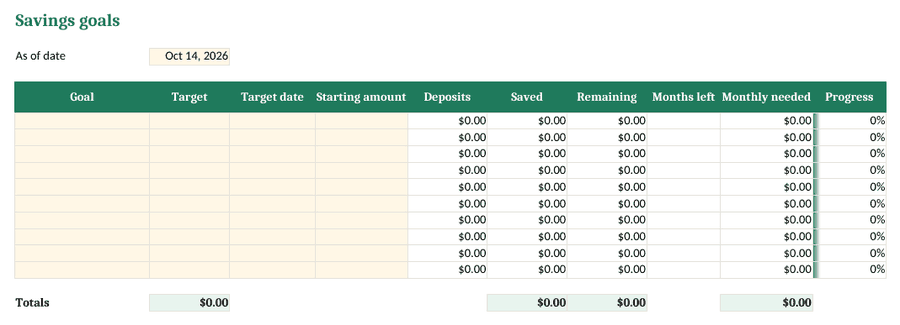
This example uses made-up sample data. We entered it in a copy of the Savings Goals Tracker and recalculated the workbook from its own formulas in LibreOffice, with the As of date fixed to February 28, 2027.
Step 1: set up the goal
On the Goals tab, we entered one goal:
- Goal: 52 week challenge
- Target: $1,378
- Target date: December 31, 2027
- Starting amount: $0
Step 2: log the first 8 weeks
On the Deposits tab, we logged one deposit per week, picking the goal from the dropdown each time:
- January 4, 2027: $1 (week 1)
- January 11, 2027: $2 (week 2)
- January 18, 2027: $3 (week 3)
- January 25, 2027: $4 (week 4)
- February 1, 2027: $5 (week 5)
- February 8, 2027: $6 (week 6)
- February 15, 2027: $7 (week 7)
- February 22, 2027: $8 (week 8)
Step 3: what the Goals tab shows
After recalculating with an As of date of February 28, 2027, the goal's row showed:
- Deposits: $36.00
- Saved: $36.00
- Remaining: $1,342.00 ($1,378 minus $36)
- Months left: 10 (March through December 2027)
- Monthly needed: $134.20 ($1,342.00 / 10)
- Progress: 3% (the Progress column is formatted as a whole percent; $36 / $1,378 is 2.61% before that rounding)
Step 4: read the monthly amount the right way
The tracker's Monthly needed column spreads what is left evenly over the months left. That is $134.20 a month in this example. The challenge schedule does not spread it evenly. From March through December 2027, the weekly deposits add up to the same $1,342 ($55 + $62 + $100 + $98 + $114 + $165 + $150 + $166 + $230 + $202), but they start at $55 in March and reach $230 in November.
So if you follow the weekly schedule, you will be below the $134.20 even pace from March through July and above it from August through December. That is expected. What matters is that the Remaining column keeps falling and reaches $0.00 by the target date. The progress bar shows how far along you are at a glance.
If you skip a week or withdraw money, log it as it happened. The Deposits tab takes withdrawals as negative amounts, and the Goals tab updates Saved, Remaining and Monthly needed from the log.
Keeping the challenge on track
- Pick a deposit day. Matching it to the day you usually get paid can make it easier to remember.
- Log every deposit. A dated log makes it easy to see which week you are on and whether you missed one.
- Plan for the 5-deposit months. In a January 2027 start, March, May, August and November each have 5 deposits.
- Run it alongside other goals. The challenge can sit next to an emergency fund or a sinking fund as its own goal. For sizing other targets, see how to set a savings goal and how to build an emergency fund.
Tracking it in a spreadsheet
The Savings Goals Tracker costs $12. It tracks up to 10 goals at once, with a deposit log, the monthly amount needed to hit each target date, and visual progress bars. It also has an emergency fund months-of-expenses calculator.
If you also want the challenge in your monthly spending plan, the Monthly Budget costs $12 and has Savings type categories where the monthly amount can go.
Both are built for Excel. They only track the numbers you enter; they do not move or hold any money.
Sources
- CFPB, Savings plan (Your Money, Your Goals toolkit): a weekly savings target as manageable pieces, and the $1,000 in about 40 weeks, $25 a week example
- Savings Goals Tracker template page and Monthly Budget template page: features and prices
- Challenge totals, running totals, reverse totals, multiplied totals and the 2027 month-by-month deposits: computed with a script, using a Monday, January 4, 2027 start
- Worked example results: entered as made-up sample data and recalculated from the tracker's own formulas in LibreOffice with an As of date of February 28, 2027
FAQ
How does the 52 week savings challenge work?
You save $1 in week 1, $2 in week 2, $3 in week 3, and keep adding $1 each week until you save $52 in week 52. Each week's deposit matches the week number, so the amounts start small and grow through the year.
How much do you save with the 52 week savings challenge?
$1,378 in total. That is the sum of every whole number from 1 to 52, which is 52 x 53 / 2. It works out to an average of $26.50 a week. If you double every amount, the total is $2,756, and at five times every amount it is $6,890.
What is the reverse 52 week savings challenge?
You run the same amounts backward, saving $52 in week 1 and $1 in week 52. The total is still $1,378, but more of it is saved early. After 13 weeks the reverse version has $598 saved, compared with $91 for the standard version.
Do I have to start the challenge in January?
No. The challenge is 52 weekly deposits, so it can start in any week. A January start lines it up with the calendar year. In our example, week 1 is Monday, January 4, 2027 and week 52 is Monday, December 27, 2027.
Can I track the 52 week savings challenge in a spreadsheet?
Yes. In the Savings Goals Tracker you can enter the challenge as one goal with a $1,378 target and a target date, then log each weekly deposit on the Deposits tab. The Goals tab shows saved, remaining, months left, the monthly amount needed and progress.
Related templates
Savings Goals Tracker
Set goals, track deposits, and see the monthly amount needed to hit each one.
$12
View templateMonthly Budget
Plan every dollar for the month and see what is left at a glance.
$12
View template