1099-K vs 1099-NEC: What Each Form Is For
By Cells and Cents. Published November 16, 2026.
1099-K vs 1099-NEC: a Form 1099-NEC comes from a business client that paid you for services, while a Form 1099-K comes from a card processor, payment app or online marketplace and reports gross payments through it. A payment belongs on one form, not both. IRS Publication 1099 (2026) says apps and marketplaces (TPSOs) must report only if both limits are met in a calendar year: over $20,000 in payments and over 200 transactions. The IRS says the One, Big, Beautiful Bill retroactively reinstated this threshold.
This is for informational purposes only and is not tax, legal, or financial advice.
Tax year: this guide covers forms for tax years 2025 and 2026 (the 2026 forms arrive in early 2027). Every rule and figure below was checked against IRS.gov on November 13, 2026, and the sources are listed at the end.
Below we cover what each form reports, who sends it, the 1099-K reporting threshold quoted word for word from IRS pages, how to tell the two forms apart, and a worked example: a made-up freelance year in our Freelancer Income and Expense Tracker, matched against two Forms 1099-NEC and one Form 1099-K without counting anything twice.
What a Form 1099-NEC reports
A Form 1099-NEC (Nonemployee Compensation) is filed by a business that paid you for your services as a nonemployee. Box 1a holds the nonemployee compensation, which the Instructions for Forms 1099-MISC and 1099-NEC say includes fees, commissions, prizes and awards for services performed as a nonemployee.
The same instructions say that for tax years beginning after 2025, the minimum threshold amount for reporting certain payments on certain information returns increased to $2,000. So for 2026, a client generally files a Form 1099-NEC for you if it paid you at least $2,000 for services in the course of its business.
For what is on each box and when Form 1099-NEC is due, see our guide Form 1099-NEC explained. We do not repeat those due dates here.
What a Form 1099-K reports
The IRS page Understanding your Form 1099-K describes Form 1099-K as "a report of payments you received for goods or services during the year from" two sources:
- Credit, debit or stored value cards such as gift cards (payment cards)
- Payment apps or online marketplaces, also called third party settlement organizations or TPSOs
Payment card companies, payment apps and online marketplaces fill out the form and send it to the IRS. The same page says they must also send a copy to you by January 31.
The amount that matters most is box 1a, the gross payment amount. The IRS page What to do with Form 1099-K says it shows the total value of payments you received through payment card and third party network transactions, and that it isn't adjusted for any fees, credits, refunds, shipping, cash equivalents or discounts.
The 1099-K reporting threshold
The threshold depends on how you were paid.
Payment apps and online marketplaces
IRS Publication 1099 (2026), General Instructions for Certain Information Returns, "For use in preparing 2026 Returns," says under the heading "Form 1099-K reporting for calendar years beginning after 2010":
"Third-party settlement organizations (TPSOs) must report transactions under section 6050W(e) only if, in a calendar year, both of the following are met. 1. Over $20,000 in total amount of payments. 2. Over 200 in total number of transactions."
Publication 1099 (2026) is for use in preparing 2026 returns and states that rule under a heading that covers calendar years beginning after 2010. It does not limit the threshold to 2025 and 2026. The IRS news release IR-2025-107 (Oct. 23, 2025) says the One, Big, Beautiful Bill retroactively reinstated that same threshold, which is why it also applies to tax year 2025:
"The OBBB retroactively reinstated the reporting threshold in effect prior to the passage of the American Rescue Plan Act of 2021 (ARPA) so that third party settlement organizations are not required to file Forms 1099-K unless the gross amount of reportable payment transactions to a payee exceeds $20,000 and the number of transactions exceeds 200."
Both limits have to be passed. Over $20,000 with 200 or fewer transactions does not meet the threshold, and neither do 201 or more transactions totaling $20,000 or less.
If you have read about a $600 figure, IRS Fact Sheet 2025-08 says that under the ARPA threshold, TPSOs were required to file Form 1099-K for any payee that received more than $600 in total payments for the sales of goods or services, regardless of the number of transactions. That is the threshold the OBBB replaced.
Payment card transactions
There is no threshold for card payments. The Form 1099-K FAQs say: "There is no threshold amount that must be met to receive a Form 1099-K due to payments received through a payment card transaction. Therefore, if you received $0.01 of payments from a payment card transaction, you should receive a Form 1099-K for those payments."
You can still get one below the threshold
The same FAQs say a TPSO may still send a Form 1099-K for amounts lower than the thresholds, and that your state may have a lower reporting threshold for TPSOs. Either way, the threshold is a rule for the payer about filing the form. It does not change what counts as income.
1099-K vs 1099-NEC side by side
- Who sends it: a 1099-NEC comes from the business that hired you. A 1099-K comes from the payment card processor, payment app or online marketplace that moved the money.
- What it covers: a 1099-NEC covers nonemployee compensation for services. A 1099-K covers payments for goods or services made through payment cards or third party networks.
- Federal threshold for 2026: a 1099-NEC is generally filed when a client paid you at least $2,000. A 1099-K from an app or marketplace is required over $20,000 and over 200 transactions, and card payments have no threshold.
- Which box to read: box 1a on both forms, but on a 1099-K it is a gross amount before fees and refunds.
Why one payment should not be on both
The Instructions for Forms 1099-MISC and 1099-NEC say payments made with a credit card or payment card and certain other types of payments, including third-party network transactions, must be reported on Form 1099-K by the payment settlement entity and are not subject to reporting on Form 1099-MISC or Form 1099-NEC.
Fact Sheet 2025-08 says the same thing from the other direction: if a transaction would be reportable on both, it "should only be reported on Form 1099-K."
So if a client pays your invoice by card or through a payment app, expect that payment on a 1099-K, not on that client's 1099-NEC. If it shows up on both, it is still one payment.
Do you report income without a form?
Yes. The IRS page Understanding your Form 1099-K says, "Whether or not you receive a Form 1099-K, you must still report any income on your tax return." The What to do with Form 1099-K page adds that you must report all income you receive, which may include the gross amount on Form 1099-K and amounts on Form 1099-NEC or Form 1099-MISC, and also amounts not reported on forms, such as cash.
The same page says a gig worker, freelancer, hobby seller or other self-employed person is considered a sole proprietor and should report Form 1099-K payment information on Schedule C (Form 1040). If a client pays you less than the 1099-NEC threshold and sends no form, that income still counts. See how to report self-employment income without a 1099.
Personal payments are different. The IRS says money from friends and family as a gift or as repayment for a personal expense should not be reported on a Form 1099-K, and that these payments aren't taxable income. If you get a 1099-K you should not have, the IRS says to contact the issuer and ask for a corrected form.
Worked example: matching two 1099-NECs and a 1099-K
This example uses made-up sample data for a freelance designer's 2026. We entered it in a copy of the Freelancer Income and Expense Tracker, recalculated the workbook from its own formulas in LibreOffice, and checked the reconciliation with a short script. The client names are invented. These are sample numbers only.
Step 1: the Income tab
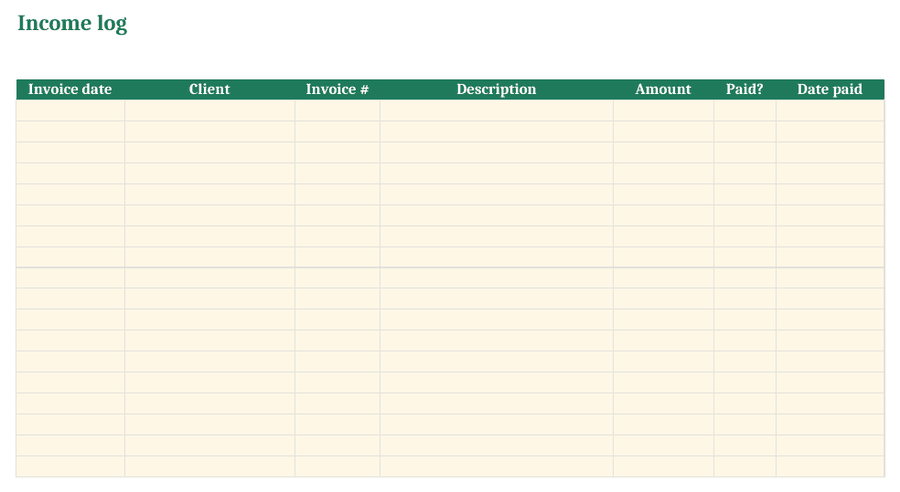
- Feb 9, 2026: Birch Hill Studio, INV-201, brand guide paid by bank transfer, $4,000.00, Paid: Yes, paid Feb 20, 2026
- May 4, 2026: Birch Hill Studio, INV-202, social templates paid by bank transfer, $3,500.00, Paid: Yes, paid May 15, 2026
- Jul 13, 2026: Tidewater Books, INV-203, cover design paid by check, $2,400.00, Paid: Yes, paid Jul 24, 2026
- Sep 8, 2026: Lantern Yoga, INV-204, flyer set paid by bank transfer, $1,500.00, Paid: Yes, paid Sep 18, 2026
- Oct 5, 2026: Quarry Street Cafe, INV-205, menu redesign paid by credit card, $3,000.00, Paid: Yes, paid Oct 6, 2026
- Dec 7, 2026: Tidewater Books, INV-206, back cover layout, $1,800.00, Paid: No
The card payment for INV-205 is logged at its full $3,000.00. The card processor kept a made-up fee of $87.30, so $2,912.70 reached the bank. The fee goes on the Expenses tab under the Bank and payment fees category, next to a $480.00 software plan under Software and subscriptions.
Step 2: what the Dashboard shows
- Income received, year to date: $14,400.00
- Expenses: $567.30 ($480.00 + $87.30)
- Profit: $13,832.70
- Unpaid invoices: $1,800.00 (1 invoice, INV-206)
Only invoices marked Paid count as income received, so INV-206 stays out of the $14,400.00.
Step 3: the forms that arrive (made-up)
- Form 1099-NEC from Birch Hill Studio, box 1a: $7,500.00 (INV-201 $4,000.00 + INV-202 $3,500.00)
- Form 1099-NEC from Tidewater Books, box 1a: $2,400.00 (only INV-203 was paid in 2026)
- Form 1099-K from the card processor, box 1a: $3,000.00 (the Quarry Street Cafe card payment, gross, before the fee)
- No form from Lantern Yoga: it paid $1,500.00, below the $2,000 threshold for 2026
- No 1099-NEC from Quarry Street Cafe: it paid by card, so that payment belongs on the 1099-K
Total of all three forms: $9,900.00 of 1099-NEC plus $3,000.00 of 1099-K = $12,900.00.
Step 4: reconcile, then stop
- Tracker income received ($14,400.00) minus all forms ($12,900.00) = $1,500.00.
- That $1,500.00 is exactly INV-204 from Lantern Yoga, which had no form. It is still income.
- The 1099-K's $3,000.00 matches INV-205 at its full amount, because the tracker logged the gross invoice and put the $87.30 fee in expenses. If you had logged only the $2,912.70 bank deposit as income, your records would sit $87.30 below the 1099-K.
The double-counting trap is adding the forms on top of your own records. $14,400.00 of logged income plus $12,900.00 of forms would be $27,300.00, which counts $12,900.00 twice. In this example, the forms are a check on the Income tab, and the tracker's $14,400.00 of paid income is the gross figure, with every difference explained.
Keeping both forms straight
- Log every paid invoice once, with how it was paid, so you know which payments to expect on a 1099-K.
- Log card and app payments at the gross amount and their fees as an expense, so your records line up with box 1a.
- Keep the forms with your records, and if a payment appears on two forms, or a personal payment appears on a 1099-K, ask the issuer for a corrected form.
- Set money aside as you go. See how much to set aside for taxes when self-employed.
The Freelancer Income and Expense Tracker costs $17. It has an income log with client, invoice number and paid status, an expense log with Schedule C style categories, a monthly and year-to-date profit dashboard, an unpaid invoice tracker, and a set-aside estimate for taxes. It is built for Excel and only tracks the numbers you enter. It does not file or prepare any tax forms.
Sources
- IRS, Publication 1099 (2026), General Instructions for Certain Information Returns (Mar 19, 2026): the exact 1099-K TPSO threshold for calendar years beginning after 2010 (over $20,000 and over 200 transactions)
- IRS, IR-2025-107 (Oct. 23, 2025): the OBBB retroactively reinstated the $20,000 and 200 transaction threshold
- IRS, Fact Sheet 2025-08: the former $600 ARPA threshold, no threshold for payment card transactions, state thresholds, and no double reporting on Forms 1099-K and 1099-NEC
- IRS, Form 1099-K FAQs: General information: the payment card $0.01 example, forms below the threshold, and state thresholds
- IRS, Understanding your Form 1099-K: what the form reports, who sends it, the January 31 copy, the reporting threshold, and personal payments
- IRS, What to do with Form 1099-K: box 1a gross amount, reporting all income, Schedule C for the self-employed, and corrected forms
- IRS, About Form 1099-K and Instructions for Form 1099-K
- IRS, Instructions for Forms 1099-MISC and 1099-NEC: box 1a nonemployee compensation, the $2,000 threshold for tax years beginning after 2025, and card and third-party network payments going on Form 1099-K
- Form 1099-NEC explained: Form 1099-NEC boxes and due dates
- Freelancer Income and Expense Tracker template page: features and price
- Worked example: made-up sample data entered in a copy of the Freelancer Income and Expense Tracker and recalculated from its own formulas in LibreOffice on November 13, 2026, with the form reconciliation checked by script
FAQ
What is the difference between a 1099-K and a 1099-NEC?
A Form 1099-NEC is filed by a business client that paid you for services as a nonemployee. A Form 1099-K is filed by a payment settlement entity, such as a payment card processor, payment app or online marketplace, and reports the gross payments you received through payment card and third party network transactions. The IRS says a payment reportable on both should only be reported on Form 1099-K.
What is the 1099-K reporting threshold?
For payment apps and online marketplaces (third party settlement organizations), IRS Publication 1099 (2026) says they must report only if, in a calendar year, both of these are met. Over $20,000 in total amount of payments. Over 200 in total number of transactions. The IRS says the One, Big, Beautiful Bill retroactively reinstated this threshold. There is no threshold for payment card transactions, and your state may have a lower threshold.
Do I still have to report income if I do not get a 1099-K or 1099-NEC?
Yes. The IRS says that whether or not you receive a Form 1099-K, you must still report any income on your tax return, and that you must report income from goods, services or property even if no form arrives, including payments in cash.
Can the same payment be on both a 1099-K and a 1099-NEC?
It should not be. IRS Fact Sheet 2025-08 says a transaction reportable under both sets of rules should only be reported on Form 1099-K, not on Form 1099-NEC. If the same payment shows up on both forms, count it once in your records and ask the payer about a corrected form.
Is the gross amount on a 1099-K my income?
Not exactly. The IRS says the gross payment amount in box 1a is not adjusted for fees, credits, refunds, shipping, cash equivalents or discounts, and that you check your records for these. In our made-up example, a $3,000.00 card payment is reported in full on the 1099-K, and the $87.30 processor fee is logged as a business expense.
Related templates
Freelancer Income and Expense Tracker
Log invoices and expenses, see profit by month, and stay ready for tax time.
$17
View templateQuarterly Estimated Tax Tracker
Track 2026 estimated payments against due dates so nothing sneaks up on you.
$17
View template