Self-employment tax rate for 2026: what 15.3% covers
By Cells and Cents. Published October 18, 2026.
This is for informational purposes only and is not tax, legal, or financial advice.
The self-employment tax rate is 15.3%: 12.4% for Social Security and 2.9% for Medicare, applied to 92.35% of your net earnings. (IRS: Self-employment tax) That 15.3% is the 12.4% Social Security rate plus the 2.9% Medicare rate listed in IRS Topic 554, added together. For 2026, the 12.4% part stops at $184,500 of combined wages and self-employment earnings. A separate 0.9% additional Medicare tax can apply above $200,000 ($250,000 married filing jointly, $125,000 married filing separately).
Every rule below comes from IRS.gov. The sources are linked in each section and listed at the end.
What the 15.3% is made of
According to IRS Topic 554, the self-employment tax rate consists of 12.4% for Social Security and 2.9% for Medicare. It applies to you if you are a sole proprietor or independent contractor, a partner in a partnership, or otherwise in business for yourself, and you usually must pay it if you had net earnings from self-employment of $400 or more.
- Social Security, 12.4%: the law sets a maximum amount of net earnings subject to it. For 2026, the maximum amount of earned income (wages and net earnings from self-employment) subject to Social Security tax is $184,500 (Form 1040-ES (2026)).
- Medicare, 2.9%: all of your net earnings are subject to it, with no cap (Topic 554).
How the 15.3% rate is applied in 2026
The 2026 Self-Employment Tax and Deduction Worksheet in Form 1040-ES follows these steps:
- Start with your net earnings: gross income from your business minus ordinary and necessary business expenses (Topic 554).
- Multiply by 92.35%. That is the amount generally subject to self-employment tax.
- Multiply that amount by 2.9% for Medicare.
- For Social Security, start from the $184,500 maximum and subtract any wages subject to Social Security tax. Take the smaller of that result and the step 2 amount, and multiply by 12.4%.
- Add steps 3 and 4. That is your self-employment tax.
- Multiply step 5 by 50%. That is the deduction for one-half of self-employment tax, which you subtract when figuring AGI.
The free self-employment tax calculator does these steps for you. It shows no self-employment tax when 92.35% of your net earnings is under $400.
Worked examples: three 2026 calculator runs
Each example below was run through the free self-employment tax calculator. The inputs are made up for illustration. Results are rounded to the cent by the calculator.
Example 1: $50,000 of net earnings
Inputs:
- Net self-employment earnings (profit) for 2026: $50,000
- W-2 wages subject to Social Security (W-2 box 3, if any): $0
- Filing status (for additional Medicare tax): Single
Output, as the calculator shows it:
- Earnings subject to SE tax (92.35%): $46,175.00
- Amount under Social Security cap: $46,175.00
- Social Security (12.4%): $5,725.70
- Medicare (2.9%): $1,339.08
- Total self-employment tax: $7,064.78
- Deductible half of SE tax: $3,532.39
The math: $50,000 x 92.35% = $46,175. That is under the $184,500 cap, so all of it gets both rates: $46,175 x 12.4% = $5,725.70 and $46,175 x 2.9% = $1,339.08 (rounded). Together that is $7,064.78, and half of it is $3,532.39.
Example 2: $200,000 of net earnings, over the cap
Inputs:
- Net self-employment earnings (profit) for 2026: $200,000
- W-2 wages subject to Social Security (W-2 box 3, if any): $0
- Filing status (for additional Medicare tax): Single
Output, as the calculator shows it:
- Earnings subject to SE tax (92.35%): $184,700.00
- Amount under Social Security cap: $184,500.00
- Social Security (12.4%): $22,878.00
- Medicare (2.9%): $5,356.30
- Total self-employment tax: $28,234.30
- Deductible half of SE tax: $14,117.15
The math: $200,000 x 92.35% = $184,700, which is $200 over the $184,500 cap. Social Security applies only up to the cap: $184,500 x 12.4% = $22,878. Medicare applies to all of it: $184,700 x 2.9% = $5,356.30. The calculator shows no additional Medicare tax here, because $184,700 is under the $200,000 single threshold.
Example 3: $160,000 of net earnings plus $80,000 of W-2 wages
Inputs:
- Net self-employment earnings (profit) for 2026: $160,000
- W-2 wages subject to Social Security (W-2 box 3, if any): $80,000
- Filing status (for additional Medicare tax): Single
Output, as the calculator shows it:
- Earnings subject to SE tax (92.35%): $147,760.00
- Amount under Social Security cap: $104,500.00
- Social Security (12.4%): $12,958.00
- Medicare (2.9%): $4,285.04
- Total self-employment tax: $17,243.04
- Deductible half of SE tax: $8,621.52
- Separate note: about $249.84 in 0.9% additional Medicare tax (Form 8959), not included in the total
The math:
- $160,000 x 92.35% = $147,760
- The wages use up part of the cap: $184,500 minus $80,000 = $104,500 left for Social Security
- Social Security: $104,500 x 12.4% = $12,958
- Medicare: $147,760 x 2.9% = $4,285.04
- Total: $12,958 + $4,285.04 = $17,243.04, and half is $8,621.52
- Additional Medicare tax: the $200,000 single threshold is reduced by the $80,000 of wages, to $120,000. Self-employment income over that is $147,760 minus $120,000 = $27,760, and $27,760 x 0.9% = $249.84
Step 6 follows the method in IRS Topic 560 for people with both wages and self-employment income. Your actual figure is calculated on Form 8959.
The deductible half
When you figure your adjusted gross income, you can deduct one-half of your self-employment tax, calculated on Schedule SE (Topic 554). In Example 1, that is $3,532.39. The deduction lowers the income your income tax is figured on. It does not lower the self-employment tax itself.
When the 0.9% additional Medicare tax applies
Topic 560 says a 0.9% additional Medicare tax applies to Medicare wages and self-employment income above these thresholds:
- Married filing jointly: $250,000
- Married filing separately: $125,000
- All other filing statuses: $200,000
If you have both wages and self-employment income, the threshold for your filing status is reduced by your Medicare wages (but not below zero), and the tax applies to self-employment income above the reduced threshold. It is figured on Form 8959 (Instructions for Form 8959).
Self-employment tax is only part of the bill
Self-employment tax covers Social Security and Medicare only. Income tax is separate, and estimated tax is used to pay both (IRS: Estimated taxes). Once you have an estimate of your total 2026 tax, the free quarterly estimated tax calculator splits what is left across the remaining 2026 due dates. Those due dates, including January 15, 2027, are listed in our 2026 quarterly tax dates guide.
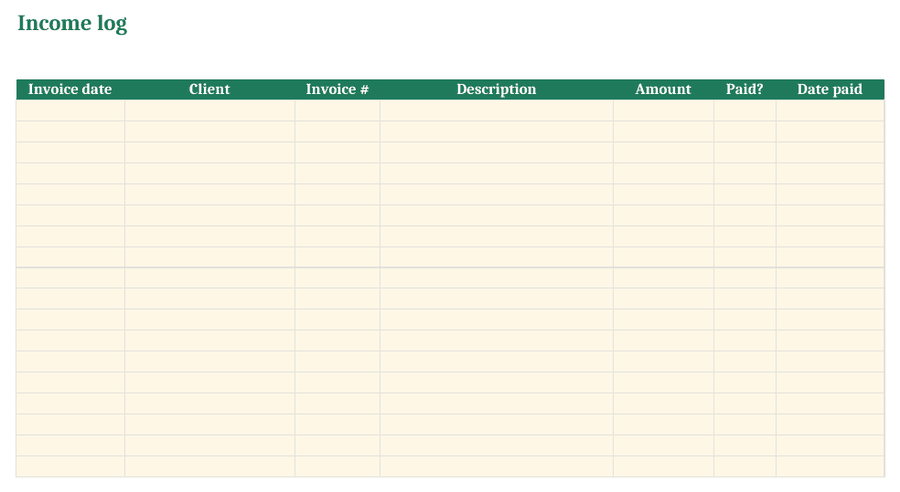
To keep your net earnings current through the year, the Freelancer Income and Expense Tracker has an income log with client, invoice number and paid status, an expense log with Schedule C style categories, a monthly and year-to-date profit dashboard, and a set-aside estimate for taxes. It costs $17.
Sources
- IRS Topic no. 554, Self-employment tax
- IRS: Self-employment tax (Social Security and Medicare taxes)
- IRS Form 1040-ES, Estimated Tax for Individuals (2026)
- IRS Topic no. 560, Additional Medicare tax
- IRS Instructions for Form 8959
- IRS: Estimated taxes
FAQ
What is the self-employment tax rate for 2026?
15.3%, made up of 12.4% for Social Security and 2.9% for Medicare. It generally applies to 92.35% of your net earnings from self-employment.
Is there a cap on self-employment tax in 2026?
The 12.4% Social Security part has one. For 2026, the maximum amount of wages and net earnings from self-employment subject to Social Security tax is $184,500. The 2.9% Medicare part has no cap.
When do I have to pay self-employment tax?
The IRS says you usually must pay it if you had net earnings from self-employment of $400 or more.
Can I deduct part of my self-employment tax?
Yes. When figuring adjusted gross income, you can deduct one-half of your self-employment tax. It is calculated on Schedule SE.
What is the 0.9% additional Medicare tax?
A 0.9% tax on Medicare wages and self-employment income above $200,000, or $250,000 if married filing jointly and $125,000 if married filing separately. It is figured on Form 8959.
Is self-employment tax the same as income tax?
No. Self-employment tax covers Social Security and Medicare. Income tax is separate, and estimated tax payments are used to pay both.
Related templates
Freelancer Income and Expense Tracker
Log invoices and expenses, see profit by month, and stay ready for tax time.
$17
View templateQuarterly Estimated Tax Tracker
Track 2026 estimated payments against due dates so nothing sneaks up on you.
$17
View template